
Non-Traditional Trademarks: Shape Marks

Non-traditional trademarks are unconventional and unique forms of trademarks. Non-traditional trademarks are less common than traditional trademarks (and certification marks and collective marks) but provide a creative and innovative way for businesses to establish and protect their brand identities.
The largest category of non-traditional trademarks is trade dress, which includes the overall look and feel of a product, product packaging, or service. Trade dress can include color marks, configuration marks, position marks, repeating pattern marks, shape marks, and texture marks. Other (non-trade dress) types of non-traditional trademarks include hologram marks, motion marks, scent marks, sound marks, and taste marks.
A shape mark is a type of trade dress consisting of a specific and recognizable shape used to identify a brand. The three-dimensional shape in a shape mark can be applied to a product or its packaging. In order to be registered as a trademark, a shape mark must be capable of identifying the source of the product, distinctive, and not protect visual features that are functional or essential to the use of the product. Shape marks are similar to, but distinct from, configuration marks (focusing on the overall design rather than just the shape alone) and position marks (protecting the specific placement of a feature on a product) – look for words like “shape” and/or “three-dimensional” in the description of the mark.
The earliest still-active shape mark registered in the US is the Coca-Cola Bottle shape mark [1], first registered April 1960 for carbonated soft drink.
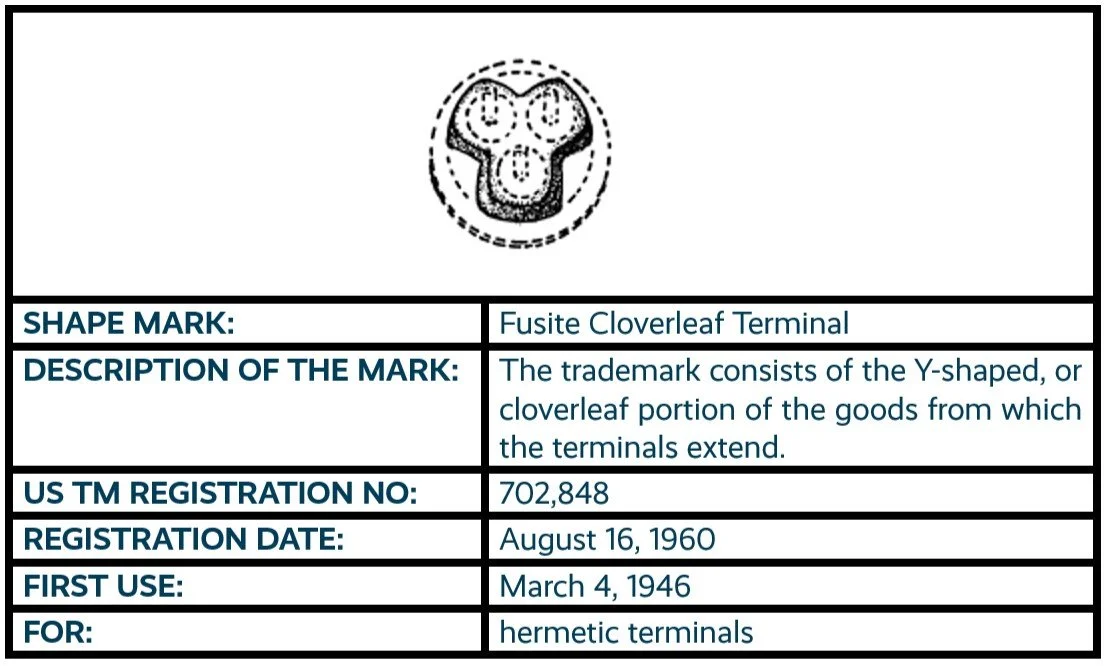
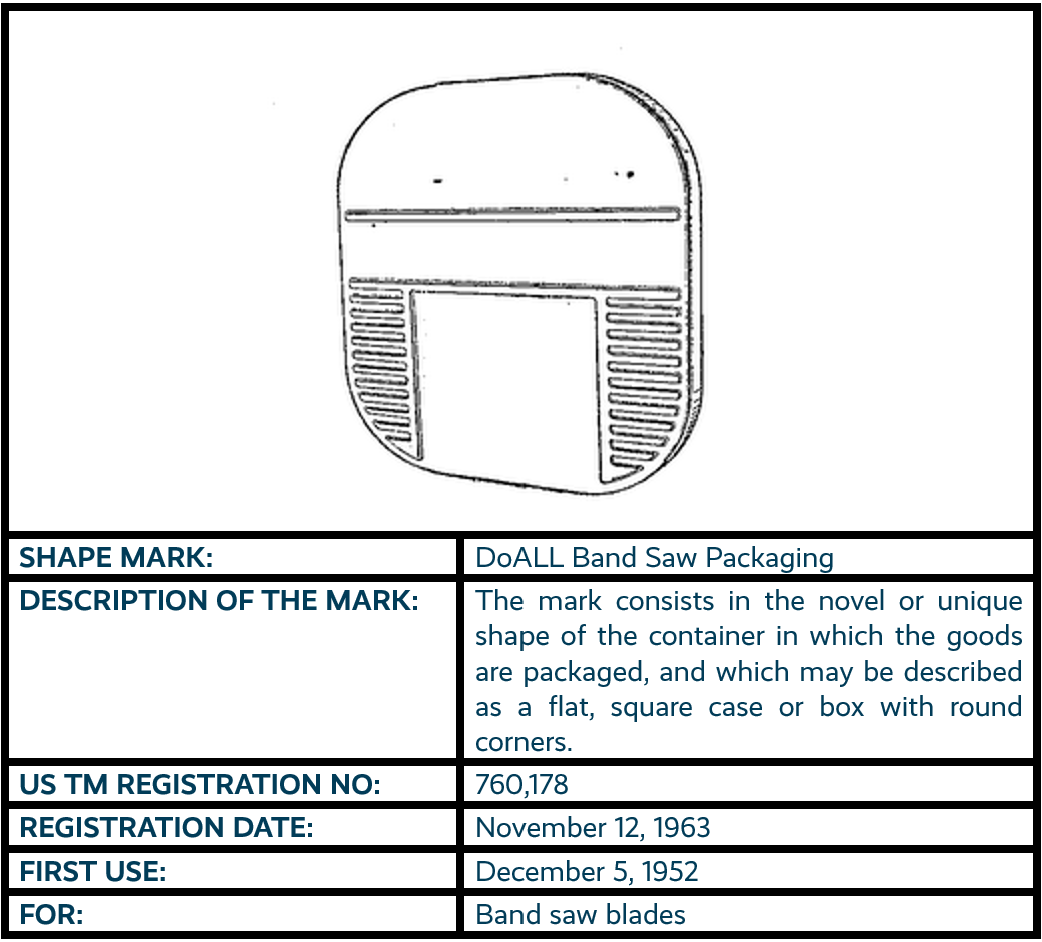
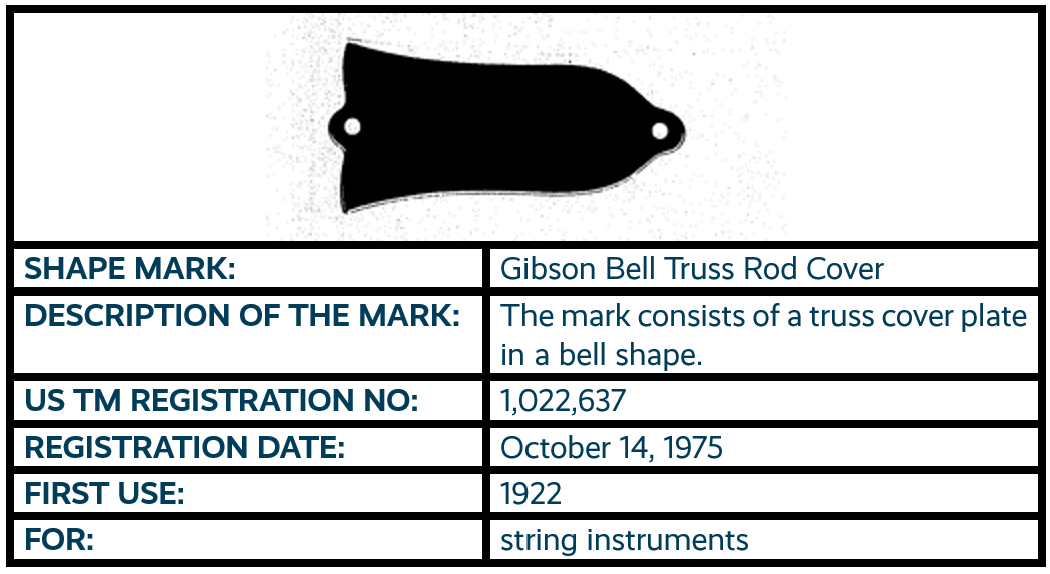
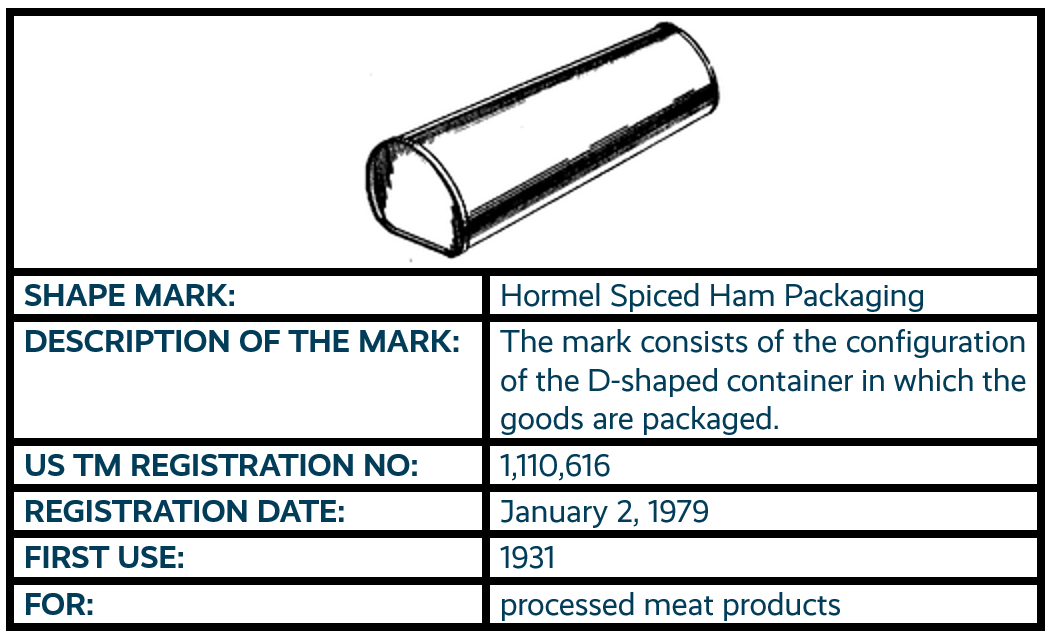
Other long-lasting shape mark registrations include the Fusite Cloverleaf Terminal shape mark [2], first registered August 1960 in connection with hermetic terminals; the DoALL Band Saw Packaging shape mark [3], first registered November 1963 for band saw blades; the Gibson Bell Truss Rod Cover shape mark [4], first registered October 14, 1975 in connection with string instruments; and the Hormel Spiced Ham Packaging shape mark [5], first registered January 2, 1979 for processed meat products.
Want to search for shape marks yourself? Head over to https://tmsearch.uspto.gov/, select “Field tag and Search Builder” from the drop down box on the left, and enter the following search string: LR:true AND RG:*principal* AND DE:(shape*)
Once you have search results, over on the left click on “Sort” and select “Serial (0-9)” to see shape marks sorted oldest to newest or “Serial (9-0)” to see shape marks sorted newest to oldest by filing date. Searching isn’t an exact science (thank you outdated trademark search tools!), especially for shape marks, so beware lots of false positives and incomplete or missing results. Have fun!
Want to learn more about trademarks? Check out our posts on Trademark Genericide, What’s a Trademark?, and Introduction.
Copyright © 2026 by Illustrated IP, LLC. All rights reserved.
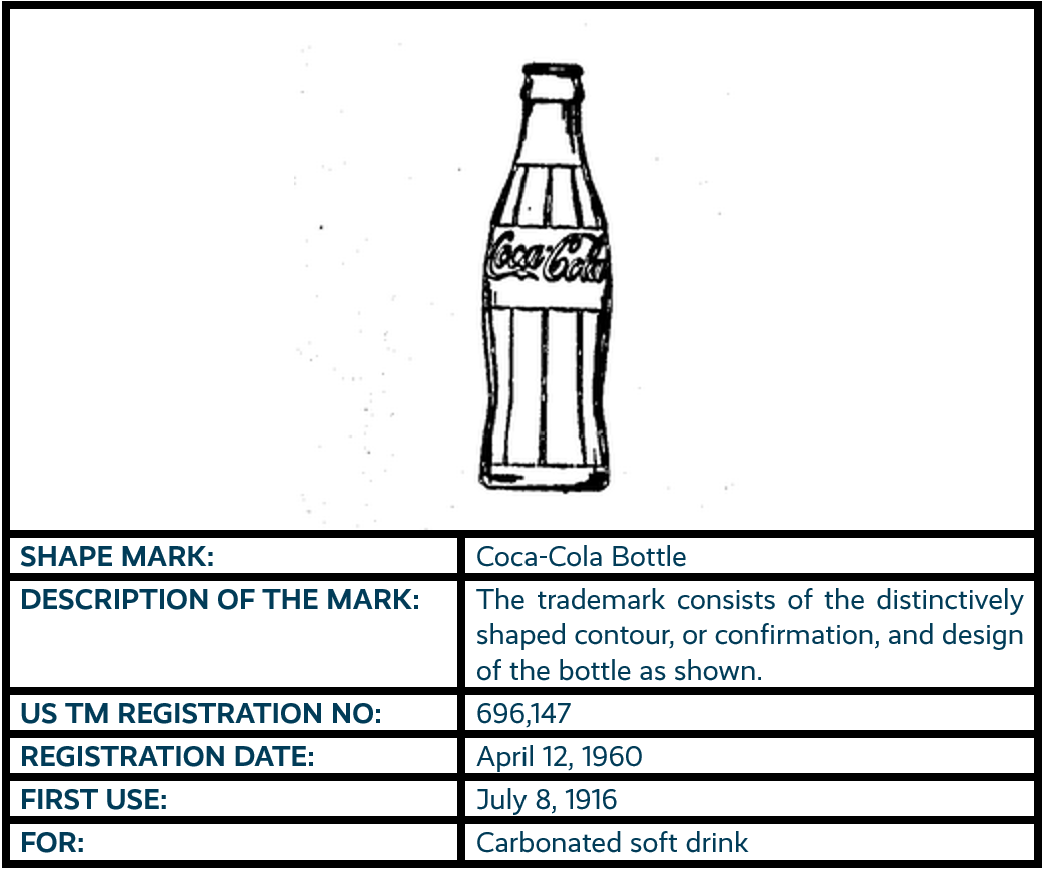
[1] USPTO, U.S. Trademark Registration No. 696,147, available at https://tsdr.uspto.gov/#caseNumber=72069873&caseSearchType=US_APPLICATION&caseType=DEFAULT&searchType=statusSearch.
[2] USPTO, U.S. Trademark Registration No. 702,848, available at https://tsdr.uspto.gov/#caseNumber=72076195&caseSearchType=US_APPLICATION&caseType=DEFAULT&searchType=statusSearch.
[3] USPTO, U.S. Trademark Registration No. 760,178, available at https://tsdr.uspto.gov/#caseNumber=72122289&caseSearchType=US_APPLICATION&caseType=DEFAULT&searchType=statusSearch.
[4] USPTO, U.S. Trademark Registration No. 1,022,637, available at https://tsdr.uspto.gov/#caseNumber=73016410&caseSearchType=US_APPLICATION&caseType=DEFAULT&searchType=statusSearch.
[5] USPTO, U.S. Trademark Registration No. 1,110,616, available at https://tsdr.uspto.gov/#caseNumber=73116210&caseSearchType=US_APPLICATION&caseType=DEFAULT&searchType=statusSearch.