
Non-Traditional Trademarks: Trade Dress

Non-traditional trademarks are unconventional and unique forms of trademarks, including trade dress, color marks, configuration marks, position marks, repeating pattern marks, shape marks, texture marks, hologram marks, motion marks, scent marks, sound marks, and taste marks. Non-traditional trademarks are much less common than traditional trademarks but provide a creative and innovative way for businesses to establish and protect their brand identities.
“Trade dress” [1] refers to the distinctive visual appearance of a product, its packaging, or a service. Trade dress encompasses a wide array of visual elements that create the overall impression of a product, its packaging, or a service, signifying the source of the product or service to consumers and helping to protect the brand identity and market presence. Trade dress can include “look and feel” non-traditional marks like color marks, configuration marks, position marks, repeating pattern marks, shape marks, and texture marks.
In order for trade dress to be registered as a trademark, the trade dress must be capable of identifying the source of the product or service, distinctive, and not protect visual features that are functional or essential to the use of the product or service. Trade dress is often difficult to register and registrations are reserved for widely known visual appearances: you see the visual appearance of a product, its packaging, or a service, and you know the company offering it.
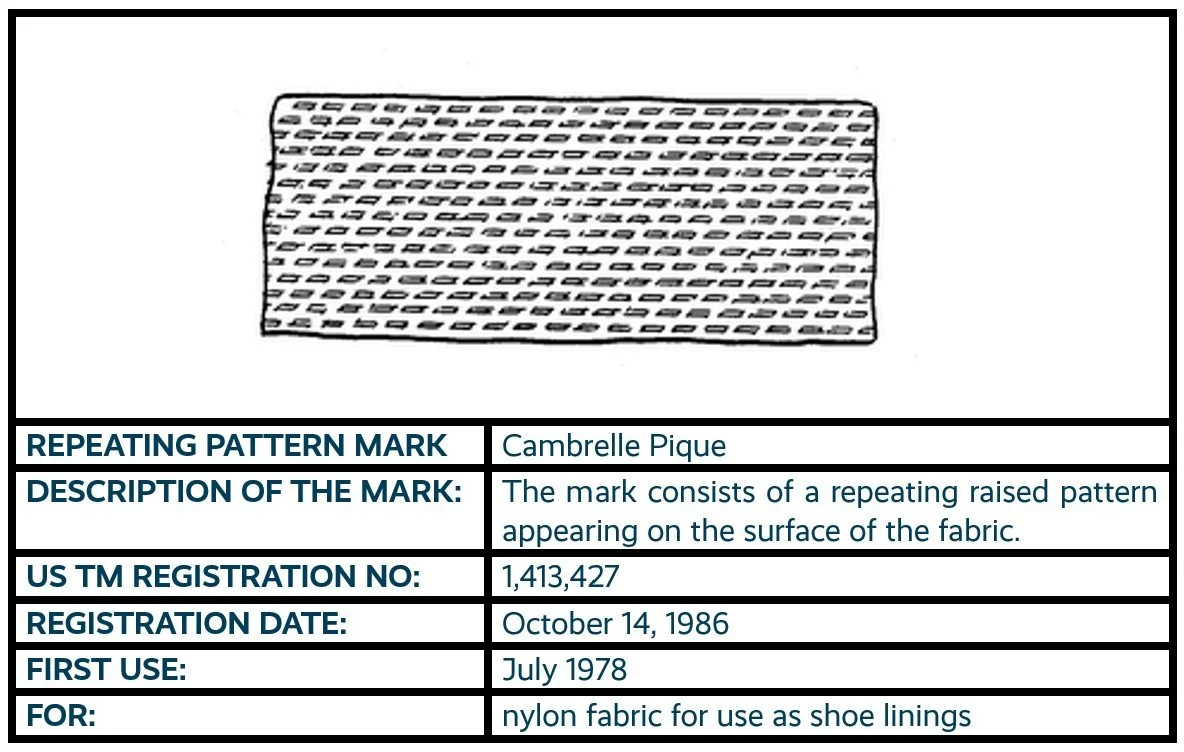
Some of the earliest still-active trade dress registrations across mark types include the Owens Corning Pink color mark, first used in 1956 and first registered in 1987 [2], the Coca-Cola Bottle shape mark, first used in 1912 and first registered in 1960 [3], the Bicycle Playing Card configuration mark, first used and first registered in 1893 [4], the Keystone Red Brand Fencing position mark, first used in 1915 and first registered in 1919 [5], the Gerber Gator Knife texture mark, first used in 1991 and first registered in 2007 [6], and the Cambrelle Pique repeating pattern mark, first used in 1978 and first registered in 1986 [7].
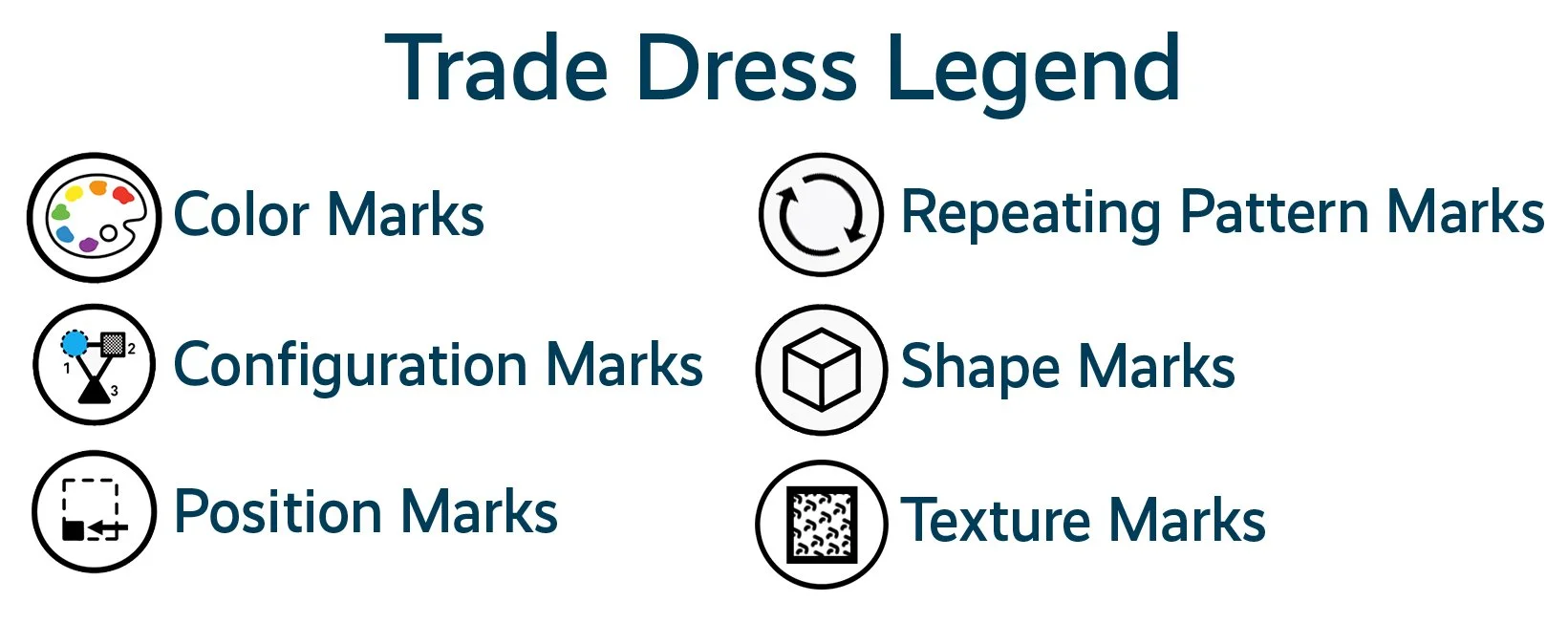
Trade Dress is the largest category of non-traditional trademarks. Our posts for trade dress always include a symbol to help indicate the type of trade dress being discussed. It will typically be obvious, but refer back to the below legend if you are ever in doubt!
Want to learn more about trademarks? Check out our posts on What's a Trademark?, US TM Registration Process, and “Intellectual” Property? Sounds Made Up.
Copyright © 2026 by Illustrated IP, LLC. All rights reserved.


[1] TMEP 1202.02 Registration of Trade Dress, available at https://tmep.uspto.gov/RDMS/TMEP/current#/current/TMEP-1200d1e835.html; Trade Dress, INTA, available at https://www.inta.org/topics/trade-dress/; US—trade dress fundamentals, LEXISNEXIS, posted May 16, 2025, and available at https://www.lexisnexis.co.uk/legal/guidance/us-trade-dress-fundamentals; INTA: How trademarks can make trade dress impress, WIPR, posted May 17, 2023, and available at https://www.worldipreview.com/trademark/inta-2023-how-trademarks-can-make-trade-dress-impress.
[2] USPTO, U.S. Trademark Registration No. 1,439,132, available at https://tsdr.uspto.gov/#caseNumber=73247707&caseSearchType=US_APPLICATION&caseType=DEFAULT&searchType=statusSearch.
[3] USPTO, U.S. Trademark Registration No. 696,147, available at https://tsdr.uspto.gov/#caseNumber=72069873&caseSearchType=US_APPLICATION&caseType=DEFAULT&searchType=statusSearch.
[4] USPTO, U.S. Trademark Registration No. 23,782, available at https://tsdr.uspto.gov/#caseNumber=70023782&caseSearchType=US_APPLICATION&caseType=DEFAULT&searchType=statusSearch.
[5] USPTO, U.S. Trademark Registration No. 125,561, available at https://tsdr.uspto.gov/#caseNumber=71109939&caseSearchType=US_APPLICATION&caseType=DEFAULT&searchType=statusSearch.
[6] USPTO, U.S. Trademark Registration No. 3,250,789, and available at https://tsdr.uspto.gov/#caseNumber=78768621&caseSearchType=US_APPLICATION&caseType=DEFAULT&searchType=statusSearch.
[7] USPTO, U.S. Trademark Registration No. 1,413,427, available at https://tsdr.uspto.gov/#caseNumber=73463623&caseSearchType=US_APPLICATION&caseType=DEFAULT&searchType=statusSearch.