
Non-Traditional Trademarks: Sound Marks
Non-traditional trademarks are unconventional and unique forms of trademarks. Non-traditional trademarks are less common than traditional trademarks (and certification marks and collective marks) but provide a creative and innovative way for businesses to establish and protect their brand identities.
The largest category of non-traditional trademarks is trade dress, which includes the overall look and feel of a product, product packaging, or service. Trade dress can include color marks, configuration marks, position marks, repeating pattern marks, shape marks, and texture marks. Other (non-trade dress) types of non-traditional trademarks include hologram marks, motion marks, scent marks, sound marks, and taste marks.
A sound mark protects distinctive sound(s) associated with a brand [1]. The sound mark must be used in connection with a good or a service and must distinctively identify that good or service as being offered by the brand owner. Commonplace sounds made in the “normal course of operation” may only be registered as a sound mark with proof of acquired distinctiveness (e.g., the sound over a long period of time has become distinctive and brand-identifying to the consuming public).
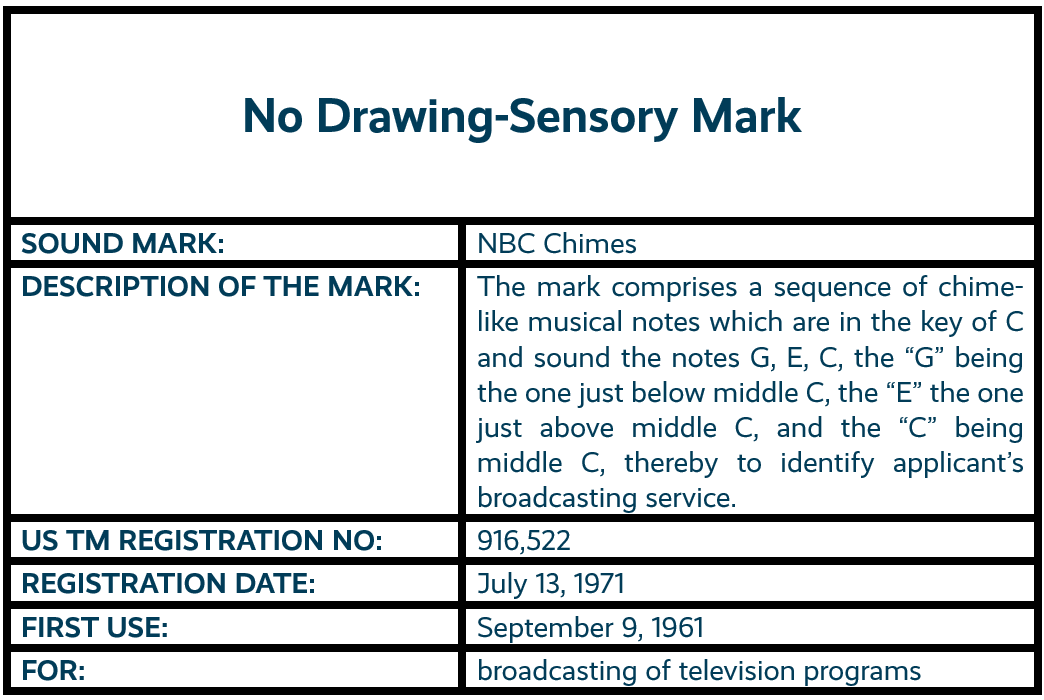
The first sound mark ever registered in the US was the NBC Chimes sound mark, first registered in April 1950 (abandoned trademark [2]), and the oldest still-active sound registration is an updated version of the NBC Chimes sound mark, registered in September 1971 (live trademark [3]).
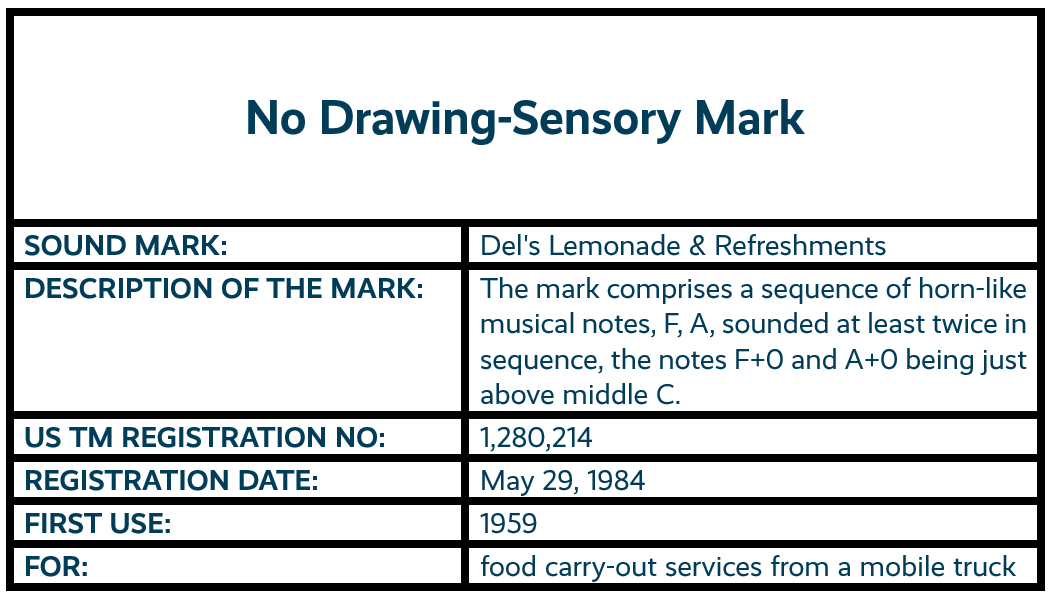
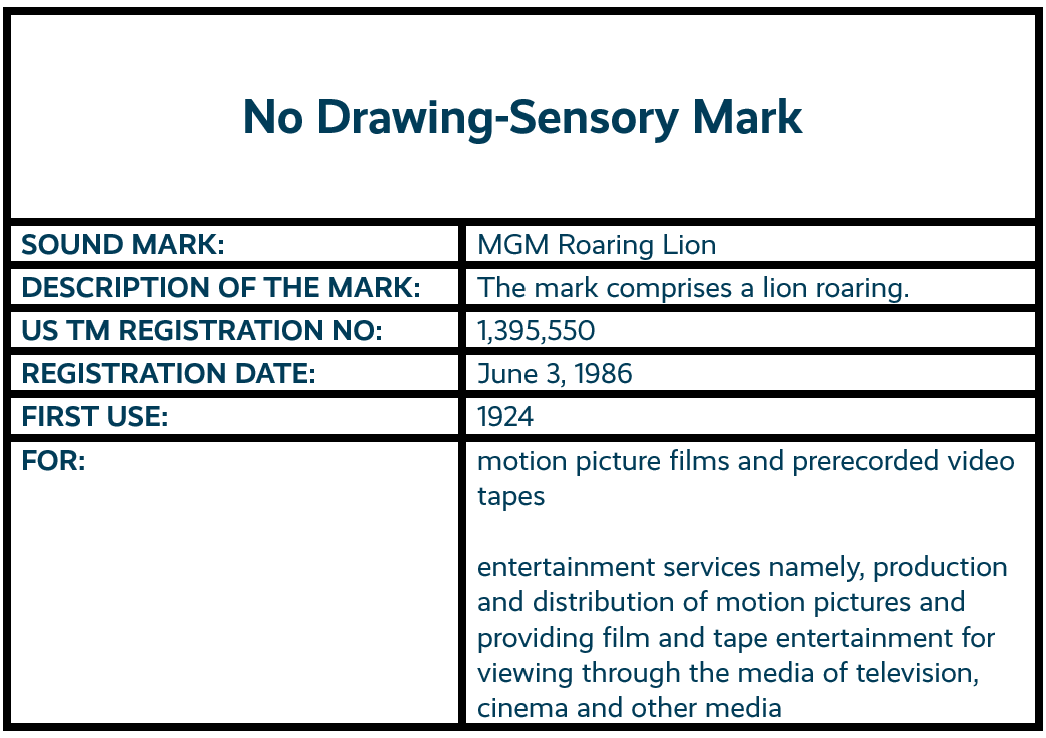
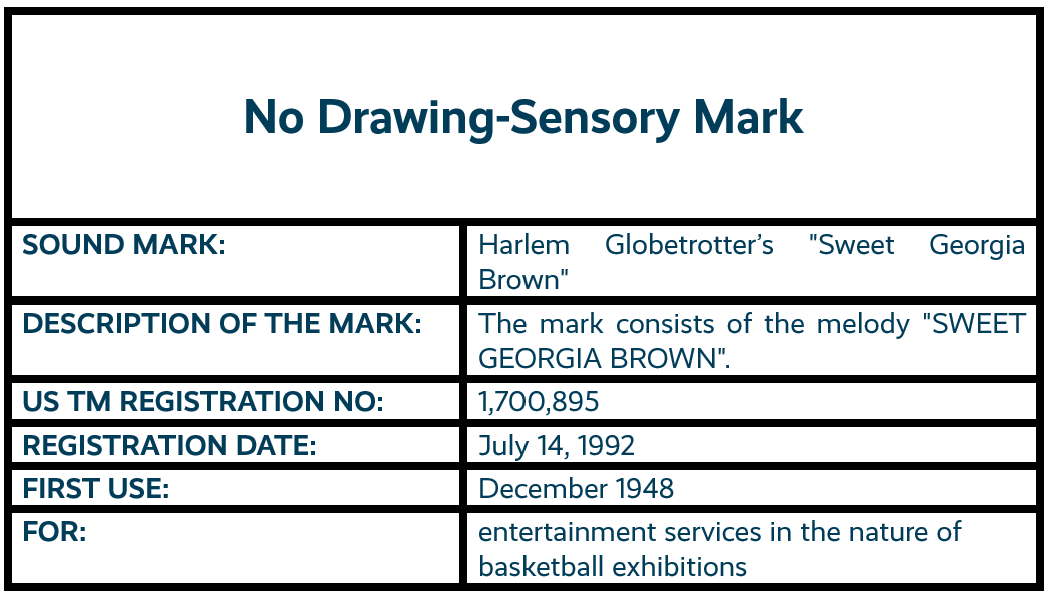
Other long-lasting sound mark registrations include the Del's Lemonade & Refreshments sound mark, first registered in May 1984 [4], the MGM Roaring Lion sound mark, first registered in June 1986 [5], and the Harlem Globetrotters "Sweet Georgia Brown" sound mark, first registered in July 1992 [6].
Want to search for sound marks yourself? Head over to https://tmsearch.uspto.gov/, select “Field tag and Search Builder” from the drop down box on the left, and try the following search strings.
for a general search of sound marks: (MD:6) AND DE:*sound* AND LR:true AND RG:*principal*
for a search of sound marks and motion marks [7]: DC:30* AND LD:true AND RG:*principal*
Once you have search results, over on the left click on “Sort” and select “Serial (0-9)” to see sound marks sorted oldest to newest or “Serial (9-0)” to see sound marks sorted newest to oldest by filing date. Searching isn’t an exact science (thank you outdated trademark search tools!), so beware lots of false positives and incomplete or missing results. Have fun!
The USPTO also maintains a quick listing of sound mark examples. Check it out at https://www.uspto.gov/trademarks/soundmarks/trademark-sound-mark-examples.
Want to learn more about trademarks? Check out our posts on Introduction, Trademark Genericide, and the US TM Registration Process.
Copyright © 2026 by Illustrated IP, LLC. All rights reserved.
[1] Trademark Manual of Examining Procedure (TMEP) § 1202.15, available at https://tmep.uspto.gov/RDMS/TMEP/current#/current/TMEP-1200d1e2927.html.
[2] USPTO, (EXPIRED) U.S. Trademark Registration No. 523,616, and available at https://tsdr.uspto.gov/#caseNumber=71541873&caseSearchType=US_APPLICATION&caseType=DEFAULT&searchType=statusSearch.
[3] USPTO, U.S. Trademark Registration No. 916,522, available at https://tsdr.uspto.gov/#caseNumber=72349496&caseSearchType=US_APPLICATION&caseType=DEFAULT&searchType=statusSearch.
[4] USPTO, U.S. Trademark Registration No. 1,280,214, and available at https://tsdr.uspto.gov/#caseNumber=73391897&caseSearchType=US_APPLICATION&caseType=DEFAULT&searchType=statusSearch.
[5] USPTO, U.S. Trademark Registration No. 1,395,550, and available at https://tsdr.uspto.gov/#caseNumber=73553567&caseSearchType=US_APPLICATION&caseType=DEFAULT&searchType=statusSearch.
[6] USPTO, U.S. Trademark Registration No. 1,700,895, and available at https://tsdr.uspto.gov/#caseNumber=74158626&caseSearchType=US_APPLICATION&caseType=DEFAULT&searchType=statusSearch.
[7] Category 30: Sound and Motion Marks, USPTO Design Search Codes, available at https://tmdesigncodes.uspto.gov/category/30.