
Non-Traditional Trademarks: Motion Marks
Non-traditional trademarks are unconventional and unique forms of trademarks. Non-traditional trademarks are less common than traditional trademarks (and certification marks and collective marks) but provide a creative and innovative way for businesses to establish and protect their brand identities.
The largest category of non-traditional trademarks is trade dress, which includes the overall look and feel of a product, product packaging, or service. Trade dress can include color marks, configuration marks, position marks, repeating pattern marks, shape marks, and texture marks. Other (non-trade dress) types of non-traditional trademarks include hologram marks, motion marks, scent marks, sound marks, and taste marks.
A motion mark protects distinctive motion(s) or movement(s) associated with a brand, including animated images or sequences, moving aspects of products, or motions used in rendering services. The motion mark must be used in connection with a good or a service, distinctively identify the brand owner (i.e., function as a trademark), and be non-functional (e.g., the motion can’t primarily serve a functional purpose). In order to be registered as a trademark, an applicant must also prove that the motion mark has acquired distinctiveness (e.g., the motion over a long period of time has become distinctive and brand-identifying to the consuming public).
Motion marks are relatively rare amongst non-traditional trademark registrations. By one count, only around 300 motion mark applications have been filed and only roughly half of those filings are still active today [1]. But, motion marks are becoming more and more popular in recent years – nearly one-third of all motion mark filings were made since 2018 [2].
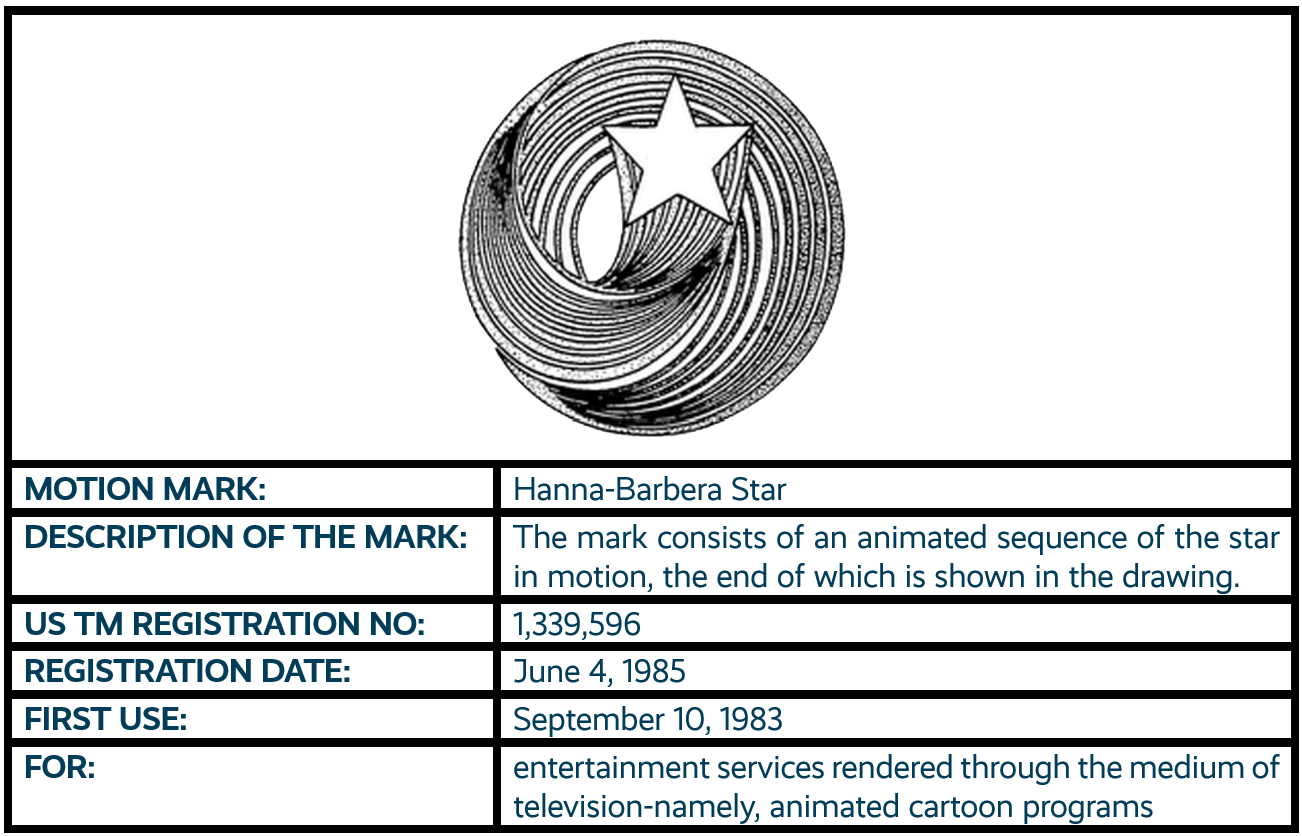
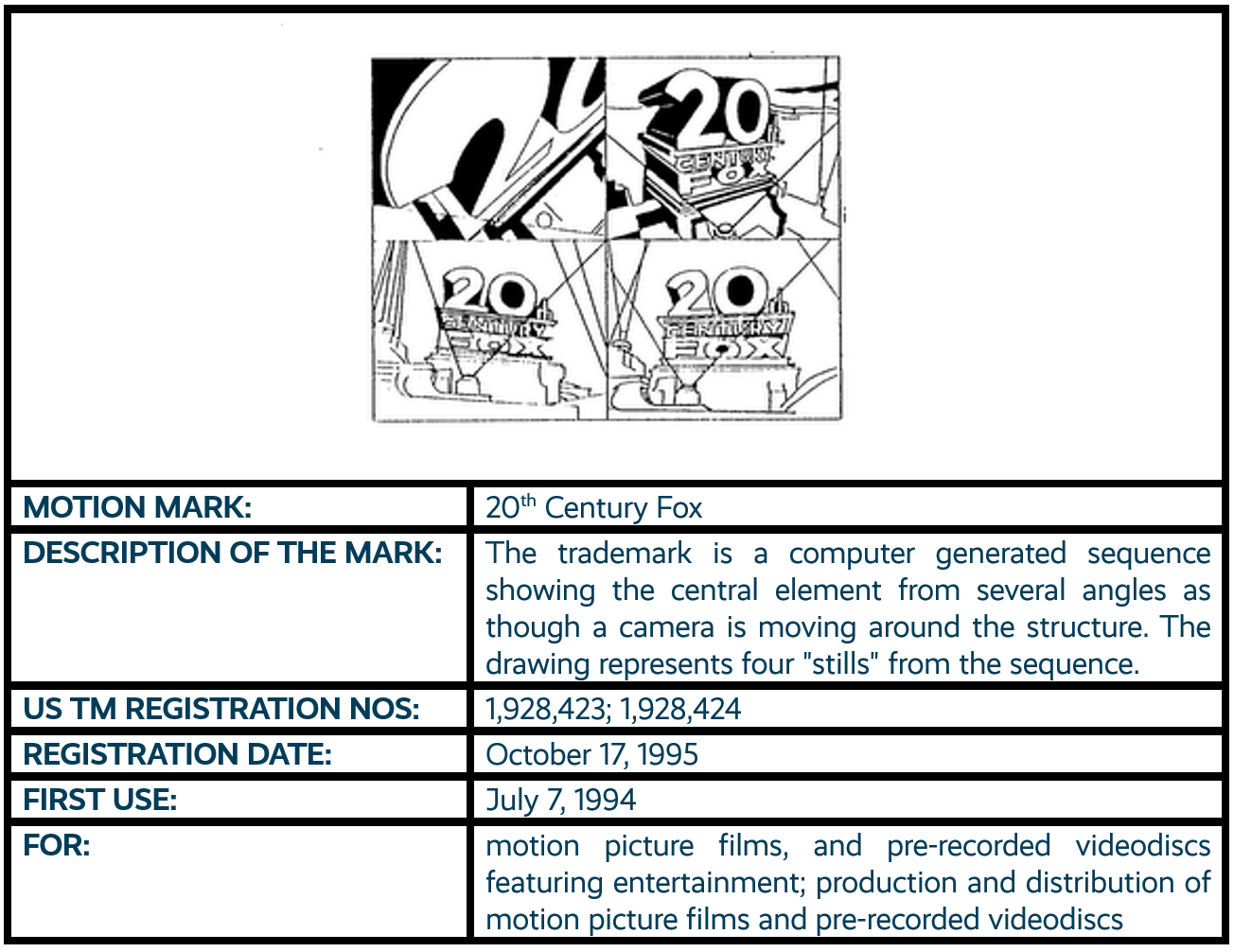
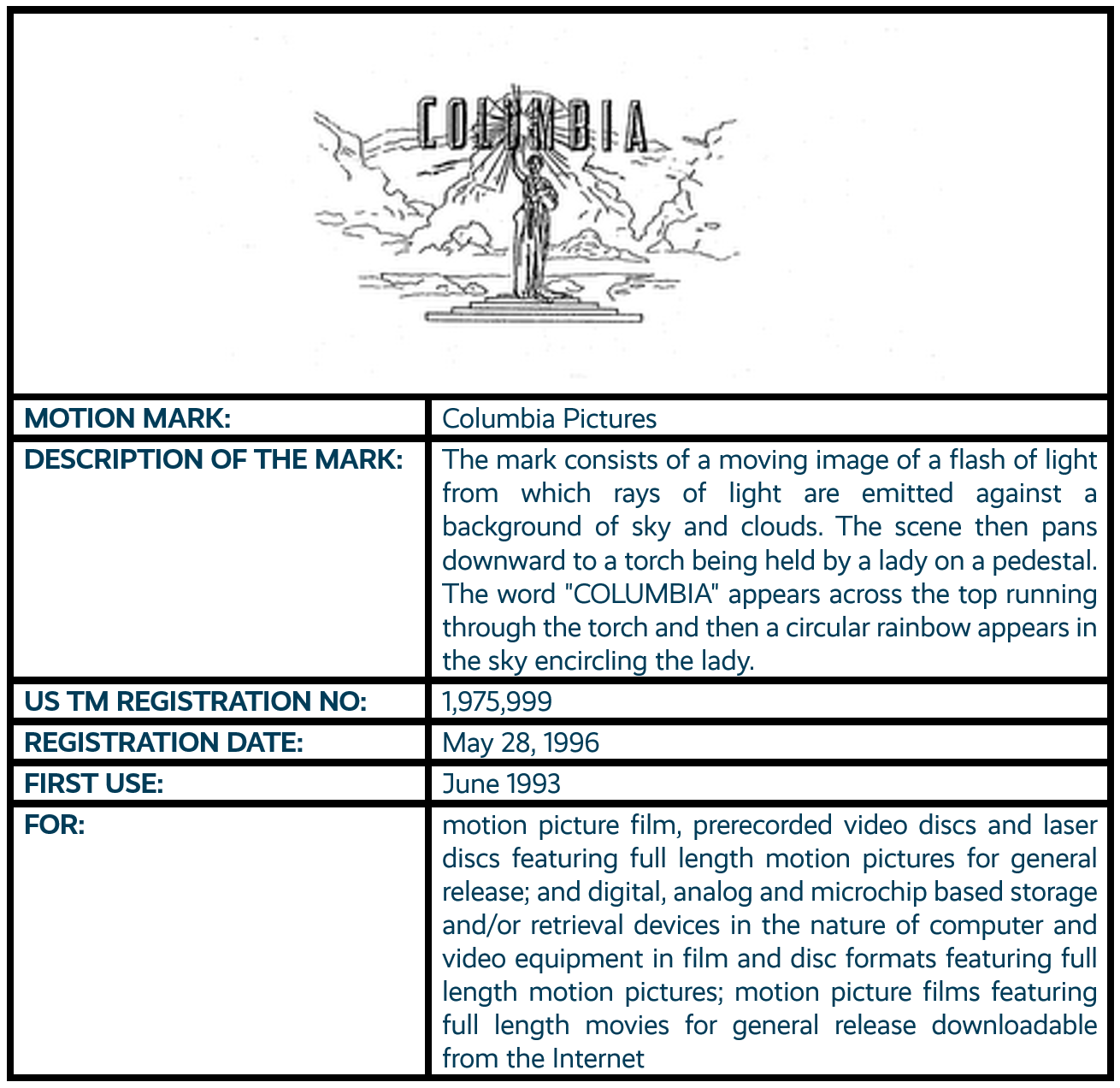
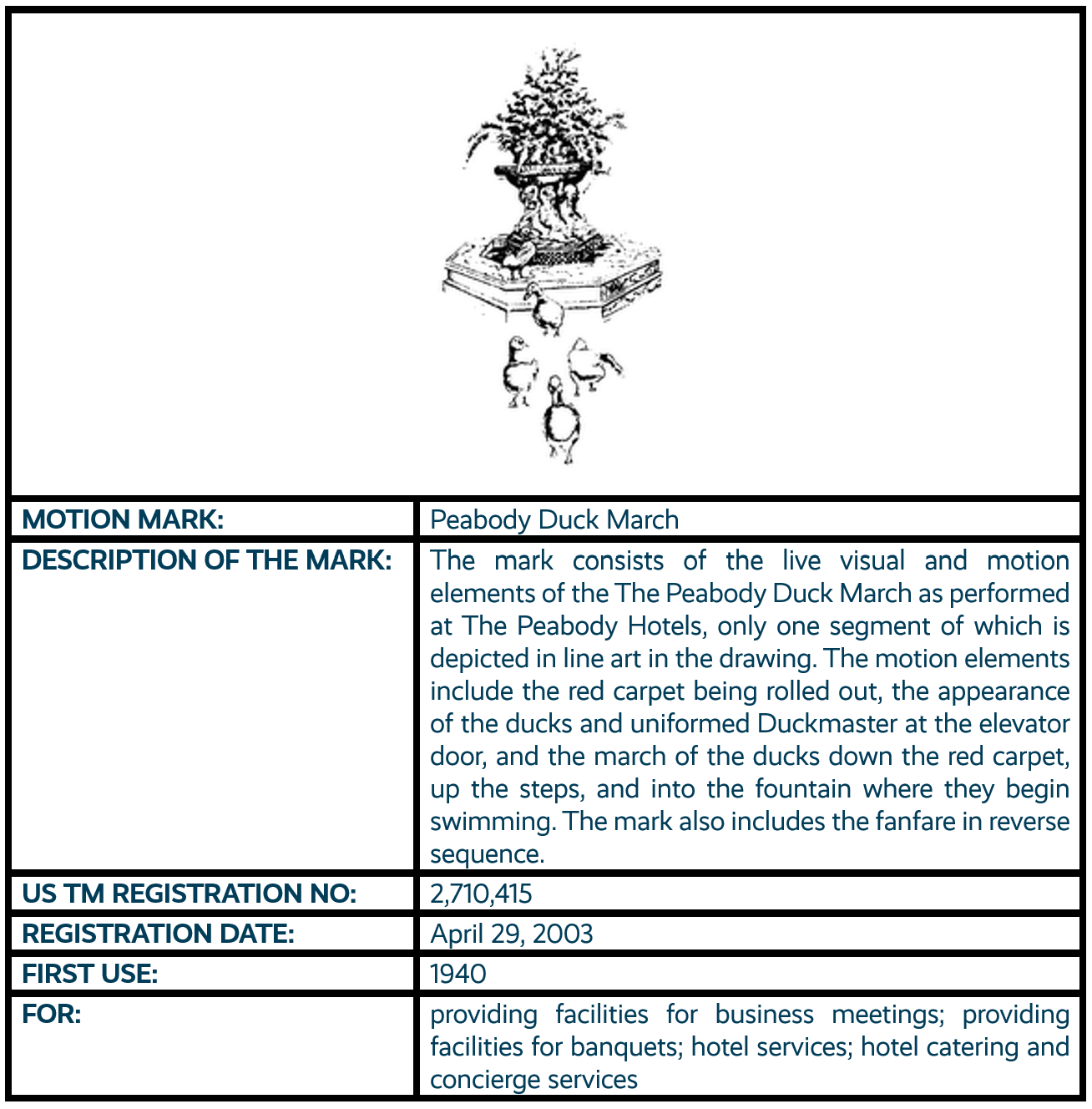
The earliest, still active motion mark is the Hanna-Barbera Star motion mark [3], first used in 1983 and first registered in 1985 in connection with entertainment services. Other long-lasting, still active motion marks including the 20th Century Fox motion mark [4], first used in 1994 and first registered in 1995 in connection with motion picture films; the Columbia Pictures motion mark [5], first used in 1993 and first registered in 1996 for motion picture films; and the Peabody Duck March motion mark [6], first used in 1940 and first registered in 2003 for hotel services and related services.
Want to search for motion marks yourself? Head over to https://tmsearch.uspto.gov/, select “Field tag and Search Builder” from the drop down box on the left, and try the following search strings.
for a general search of motion marks: (MD:2 MD:3 MD:5) AND DE:(motion* movement* moving*) AND LD:true AND RG:*principal*
for a search of sound marks and motion marks [7]: DC:30* AND LD:true AND RG:*principal*
Once you have search results, over on the left click on “Sort” and select “Serial (0-9)” to see motion marks sorted oldest to newest or “Serial (9-0)” to see motion marks sorted newest to oldest by filing date. Searching isn’t an exact science (thank you outdated trademark search tools!), so beware lots of false positives and incomplete or missing results. Have fun!
Want to learn more about trademarks? Check out our posts on Why Should I Care About Trademarks?, What’s a Trademark?, and Trademark Genericide.
Copyright © 2026 by Illustrated IP, LLC. All rights reserved.
[1] Busting a Move: Best Practices for Protecting Motion Marks in the United States, INTERNATIONAL TRADEMARK ASSOCIATION, published March 15, 2023, and available at https://www.inta.org/perspectives/features/busting-a-move-best-practices-for-protecting-motion-marks-in-the-united-states/.
[2] Id.
[3] USPTO, U.S. Trademark Registration No. 1,339,596, available at https://tsdr.uspto.gov/#caseNumber=73466392&caseSearchType=US_APPLICATION&caseType=DEFAULT&searchType=statusSearch.
[4] USPTO, U.S. Trademark Registration No. 1,928,423, available at https://tsdr.uspto.gov/#caseNumber=74606378&caseSearchType=US_APPLICATION&caseType=DEFAULT&searchType=statusSearch; USPTO, U.S. Trademark Registration No. 1,928,424, available at https://tsdr.uspto.gov/#caseNumber=74606379&caseSearchType=US_APPLICATION&caseType=DEFAULT&searchType=statusSearch.
[5] USPTO, U.S. Trademark Registration No. 1,975,999, available at https://tsdr.uspto.gov/#caseNumber=1975999&caseSearchType=US_APPLICATION&caseType=DEFAULT&searchType=statusSearch.
[6] USPTO, U.S. Trademark Registration No. 2,710,415, available at https://tsdr.uspto.gov/#caseNumber=76067691&caseSearchType=US_APPLICATION&caseType=DEFAULT&searchType=statusSearch.
[7] Category 30: Sound and Motion Marks, USPTO Design Search Codes, available at https://tmdesigncodes.uspto.gov/category/30.