
Non-Traditional Trademarks: Position Marks

Non-traditional trademarks are unconventional and unique forms of trademarks. Non-traditional trademarks are less common than traditional trademarks (and certification marks and collective marks) but provide a creative and innovative way for businesses to establish and protect their brand identities.
The largest category of non-traditional trademarks is trade dress, which includes the overall look and feel of a product, product packaging, or service. Trade dress can include color marks, configuration marks, position marks, repeating pattern marks, shape marks, and texture marks. Other (non-trade dress) types of non-traditional trademarks include hologram marks, motion marks, scent marks, sound marks, and taste marks.
A position mark is a type of trade dress consisting of the specific placement or position of features (e.g., color, shapes, etc.) or parts on a product or product packaging. In order to be registered as a trademark, a position mark must be capable of identifying the source of the product, distinctive, and not protect visual features that are functional or essential to the use of the product or product packaging.
Position marks are similar to, but distinct from, shape marks (focusing purely on the three-dimensional shape of a product) and configuration marks (focusing on the overall design rather than specific placement of a feature). When looking at a description of a position mark, look for phrasing that describes the placement or position of a feature on a product or packaging. For example, position marks often include words like “position” or “placement” in the description of the mark.
Some of the oldest, still-active position mark registrations in the US involve fencing. The oldest, still-active position mark is the Keystone Red Brand Fencing position mark [1] , first registered May 1919 for metallic fence posts (Keystone Consolidated Industries, Inc. is also the owner of several other fencing-related red color position marks).
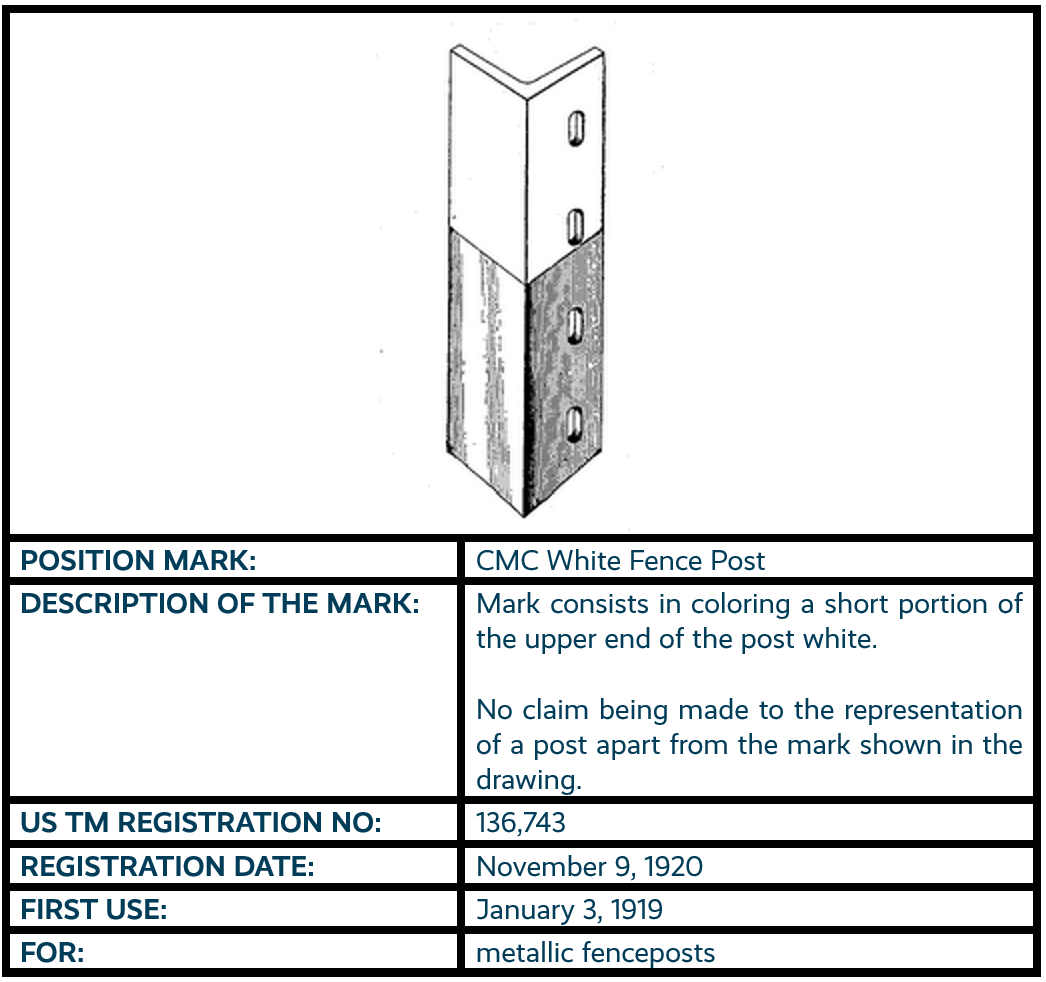
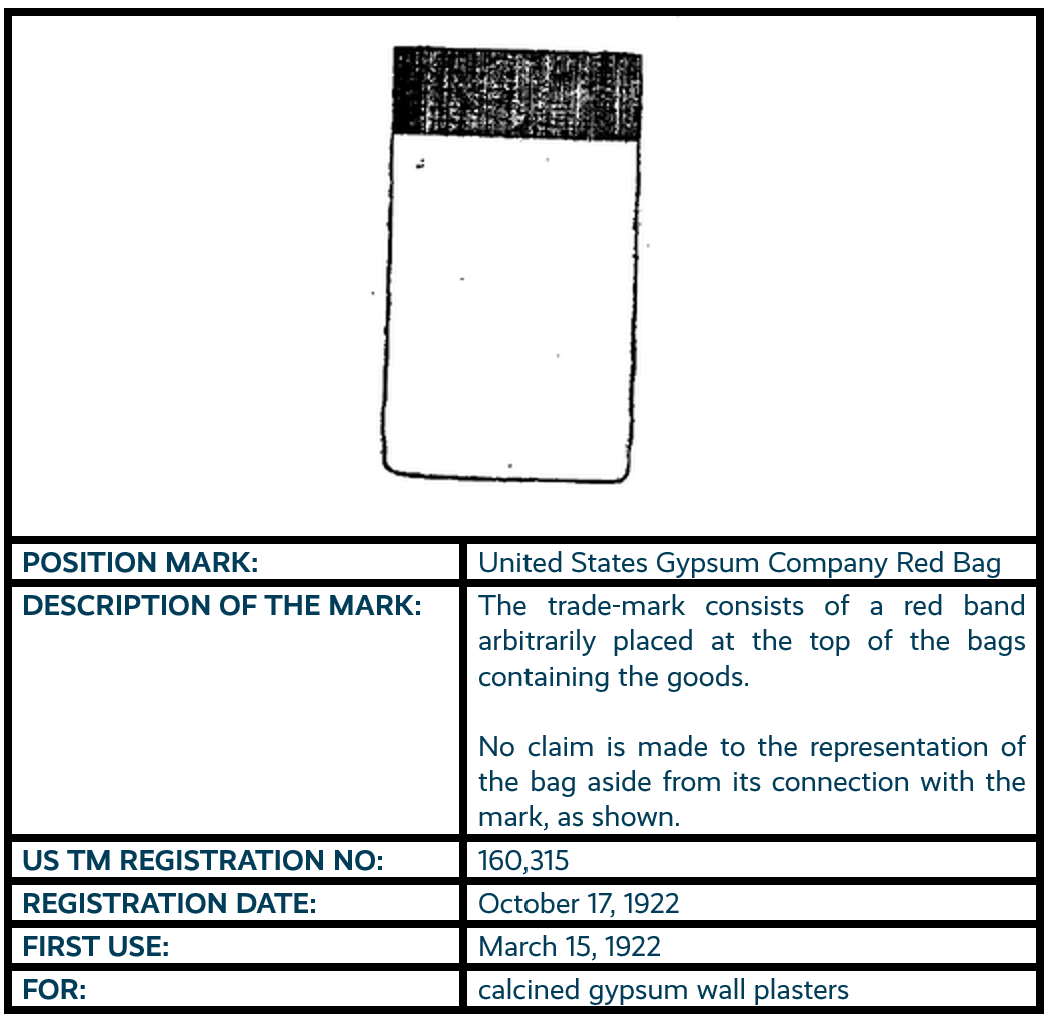
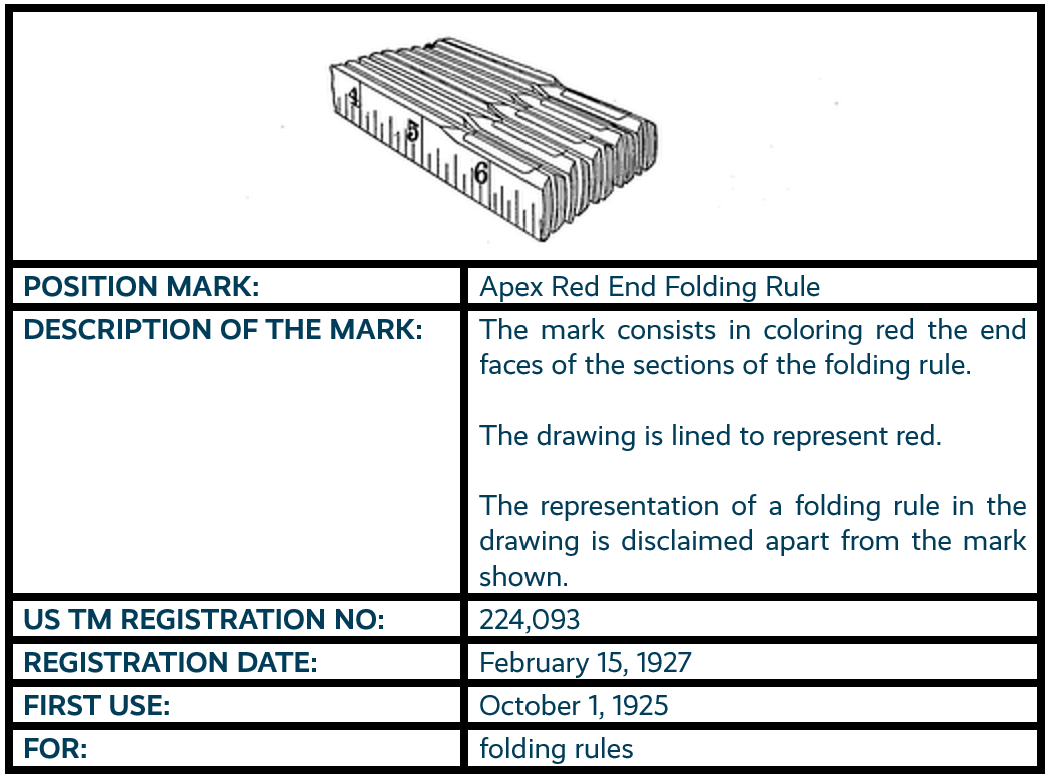
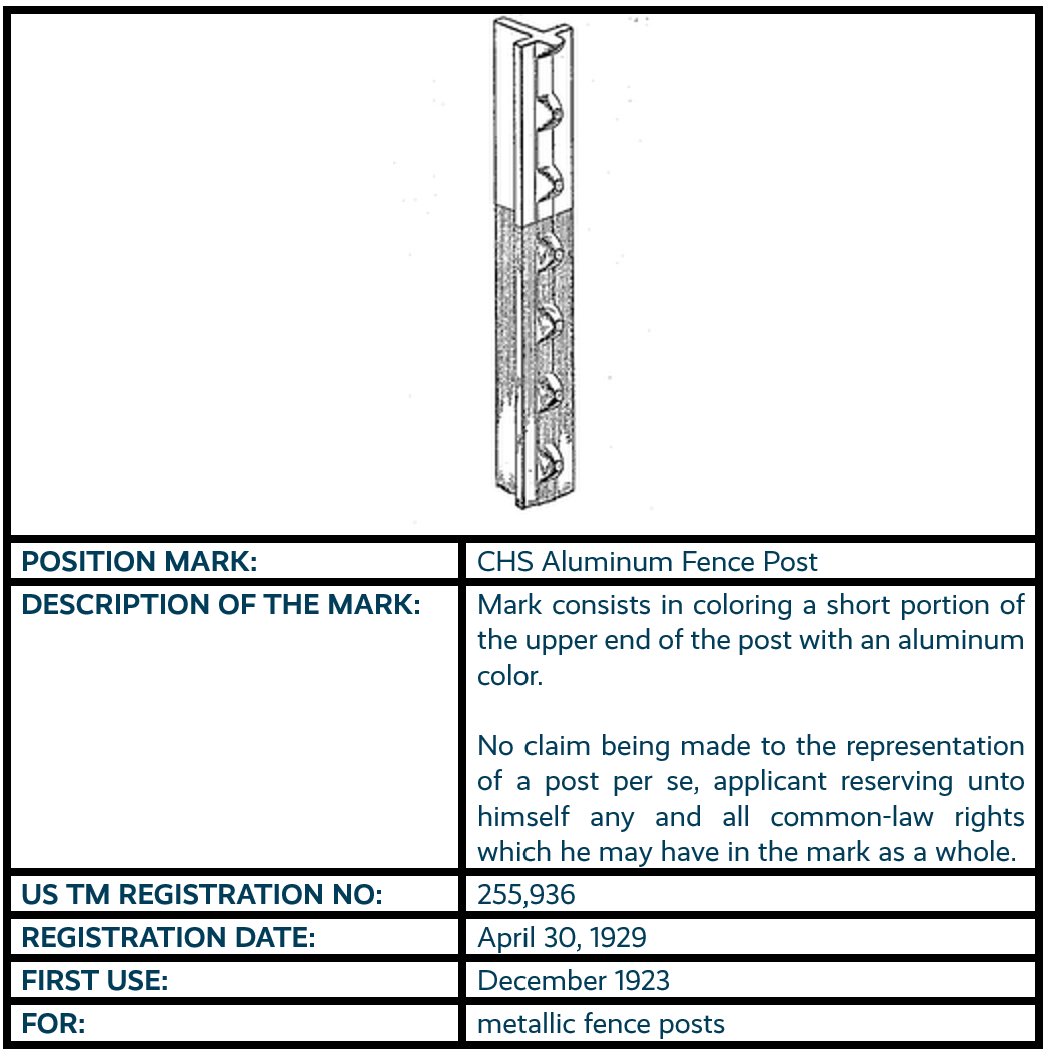
Other old, fencing-related position marks include the CMC White Fence Post position mark [2], first registered November 1920 for metallic fenceposts, and the CHS Aluminum Fence Post position mark [5], first registered April 1929 for metallic fence posts. Other old, still-active position marks also include United States Gypsum Company Red Bag position mark [3], first registered October 1922 in connection with calcined gypsum wall plasters, and the Apex Red End Folding Rule position mark [4], first registered February 1927 in connection with folding rules.
Want to search for position marks yourself? Head over to https://tmsearch.uspto.gov/, select “Field tag and Search Builder” from the drop down box on the left, and try the following search strings.
To broadly search for position marks: LR:true AND RG:*principal* AND (DE:position* OR DE:place* OR DE:portion)
To search for position marks that include color: (MD:2 MD3) AND DC:(2903*) AND LR:true AND RG:*principal*
Once you have search results, over on the left click on “Sort” and select “Serial (0-9)” to see position marks sorted oldest to newest or “Serial (9-0)” to see position marks sorted newest to oldest by filing date. Searching isn’t an exact science (thank you outdated trademark search tools!), so beware lots of false positives and incomplete or missing results. Have fun!
Want to learn more about trademarks? Check out our posts on I Think I Understand IP, But Can You Give Me An Example?, Why Should I Care About Trademarks?, and 5 More Key Facts About Trademarks.
Copyright © 2026 by Illustrated IP, LLC. All rights reserved.
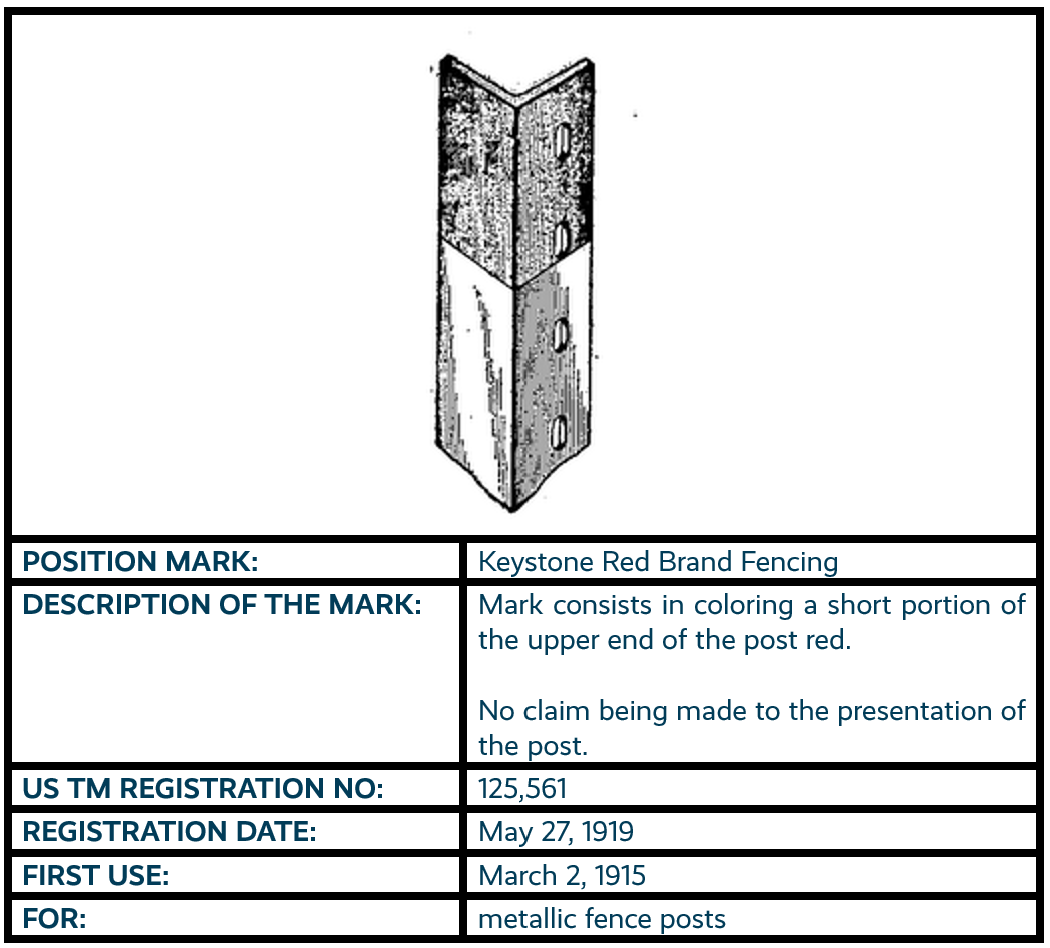
[1] USPTO, U.S. Trademark Registration No. 125,561, available at https://tsdr.uspto.gov/#caseNumber=71109939&caseSearchType=US_APPLICATION&caseType=DEFAULT&searchType=statusSearch.
[2] USPTO, U.S. Trademark Registration No. 136,743, available at https://tsdr.uspto.gov/#caseNumber=71131622&caseSearchType=US_APPLICATION&caseType=DEFAULT&searchType=statusSearch.
[3] USPTO, U.S. Trademark Registration No. 160,315, available at https://tsdr.uspto.gov/#caseNumber=71163204&caseSearchType=US_APPLICATION&caseType=DEFAULT&searchType=statusSearch.
[4] USPTO, U.S. Trademark Registration No. 224,093, available at https://tsdr.uspto.gov/#caseNumber=71226436&caseSearchType=US_APPLICATION&caseType=DEFAULT&searchType=statusSearch.
[5] USPTO, U.S. Trademark Registration No. 255,936, available at https://tsdr.uspto.gov/#caseNumber=71275377&caseSearchType=US_APPLICATION&caseType=DEFAULT&searchType=statusSearch.