
Axon Yellow
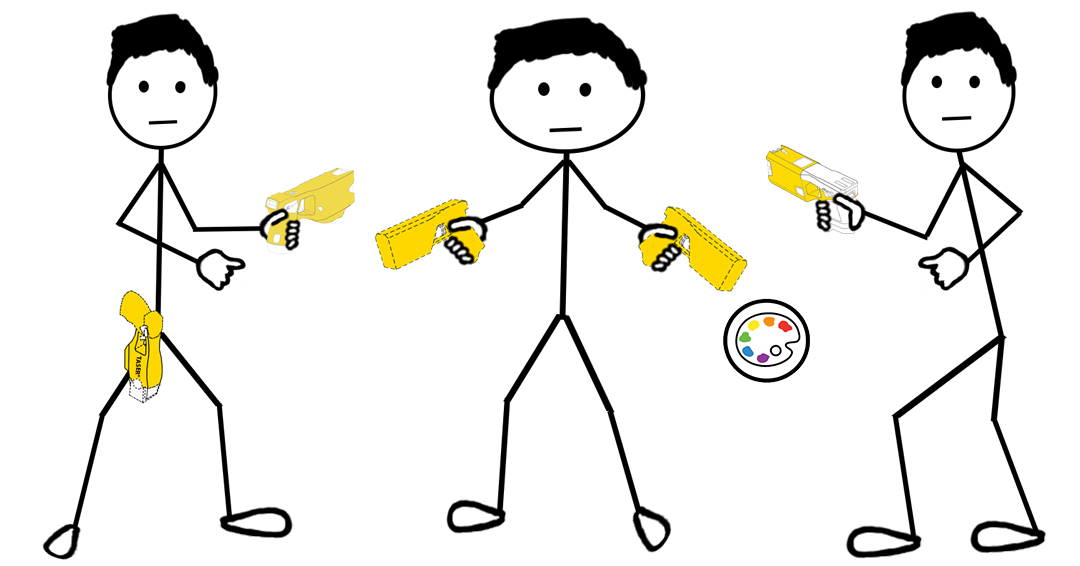
Trademark: Axon Yellow
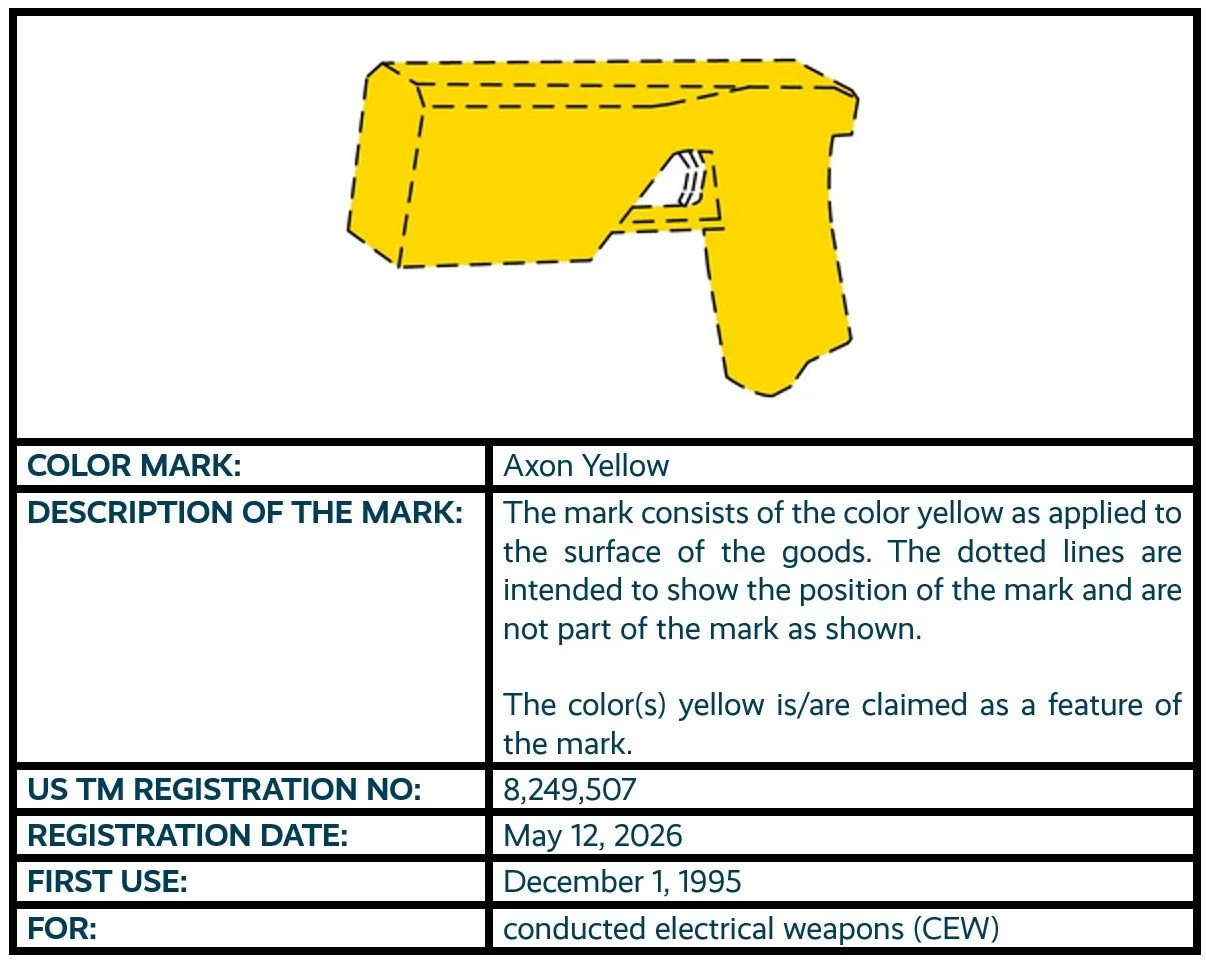
First Used: 1995
First Registered: 2026
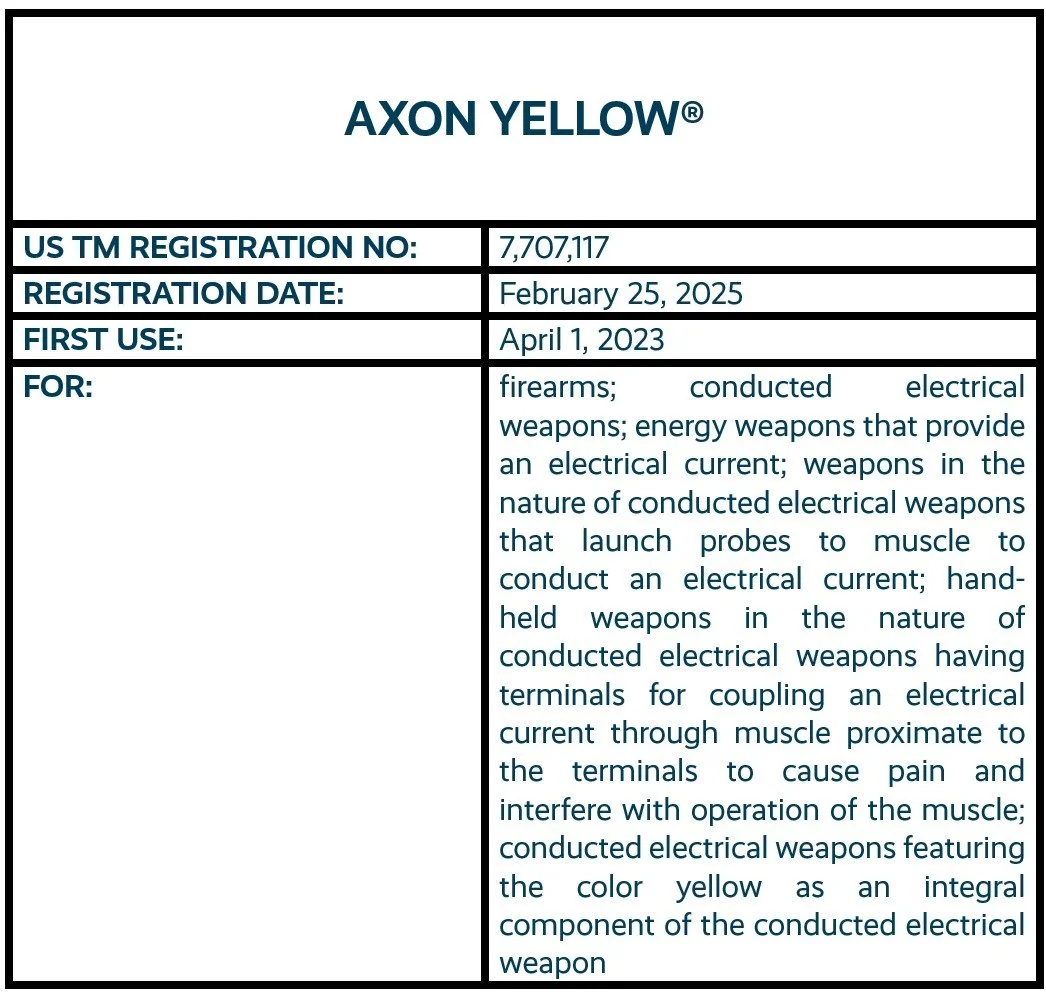
Current Owner: AXON ENTERPRISE, INC. [1]
Trademark Type: non-traditional trademark; trade dress; color mark; configuration mark
Primarily Associated With: conducted electrical weapons (CEW) [2]
Brief (and likely incomplete) History [3]:
Congratulations to Axon Enterprise for its recent successful trademark registration of the color yellow as applied to its TASER® conducted electrical weapons (CEWs). Axon calls this shade of yellow AXON YELLOW® [4] (the phrase itself is also a registered trademark) and has used the color on its CEWs, training materials, marketing campaigns, and brand initiatives for over 30 years.
Next time you see a police officer, in real life or depicted in pop culture, take a look at their uniform and duty belts and you will quickly see the yellow handle of a TASER CEW. While the Axon Yellow color is inextricably tied to the TASER brand today, did you know that the original TASER CEWs created by Jack Cover in the 1970s were only offered in neutral colors like black and grey? The Axon Yellow color was not introduced until Rick Smith created the new and improved AIR TASER in the early 1990s, when it was used for a “Sports Defender” edition. Since then, the Axon Yellow color has been available on every generation TASER model for law enforcement. Read on below to find out more about TASER devices featuring the Axon Yellow color through the years.
TASER CEWs Through The Years
AIR TASER 34000 (1994)
AIR TASER 34001 Sports Defender (1995)
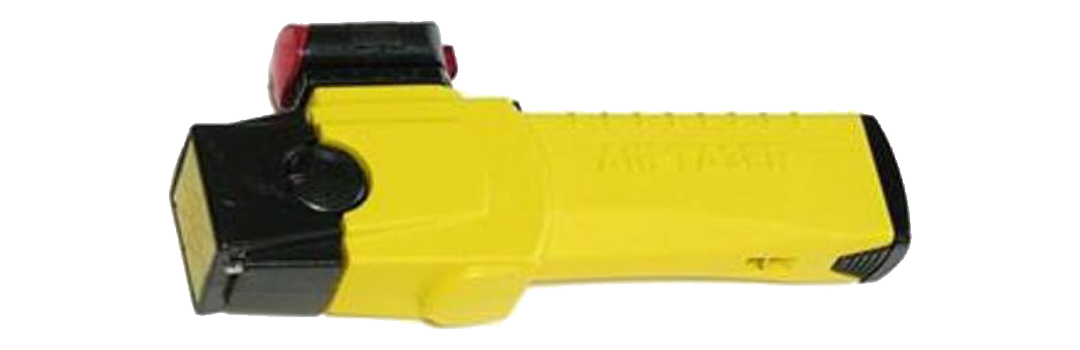
The AIR TASER 34000 marked the beginning of the modern TASER era. Unlike earlier TASER devices that relied on gunpowder charges and were regulated as firearms, the AIR TASER used compressed gas to launch its probes, making the technology more practical and accessible for civilian and law enforcement use. The device introduced the “MX Cartridge” design that quickly became the standard single-shot cartridge configuration for devices over the ensuing decades (the shape became so popular that it is also protected by a non-traditional trademark registration: MX Cartridge configuration mark). The AIR TASER 34001 Sports Defender edition was released a year later, marking the debut of the iconic yellow coloring.
ADVANCED TASER M26 (1999)

The ADVANCED TASER M26 was the first TASER device to incorporate the company's neuromuscular incapacitation (NMI) technology, allowing it to temporarily override voluntary muscle control rather than simply inflict pain. The device delivered significantly more power than earlier models and quickly gained acceptance among law enforcement agencies looking for an alternative to higher levels of force. The M26 also introduced built-in accountability features (including onboard memory and deployment records) and the distinctive handgun-style design.
TASER X26 (2003)
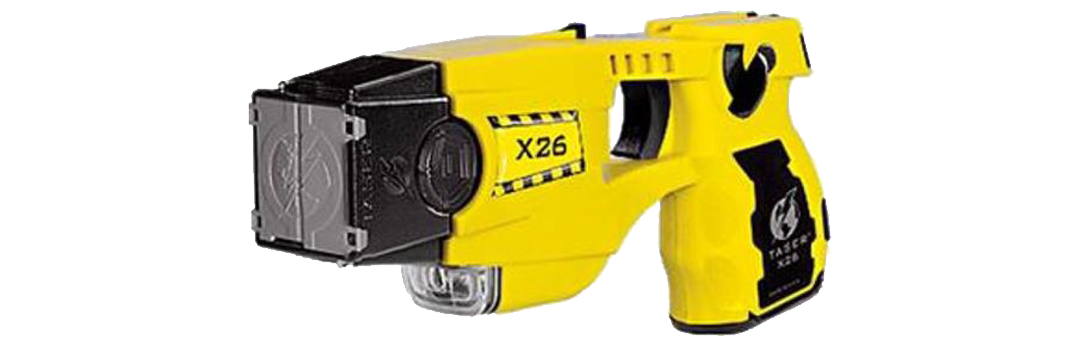
The TASER X26 was one of the most important products in company history. It introduced TASER's new Shaped Pulse technology, which increased neuromuscular incapacitation while dramatically reducing the size and weight of the device. The X26 was approximately 60% smaller and lighter than the M26, making it practical for officers to carry throughout an entire shift. The X26 quickly became the company's flagship product and helped drive widespread adoption of TASER devices around the world.
TASER X12 (2007)
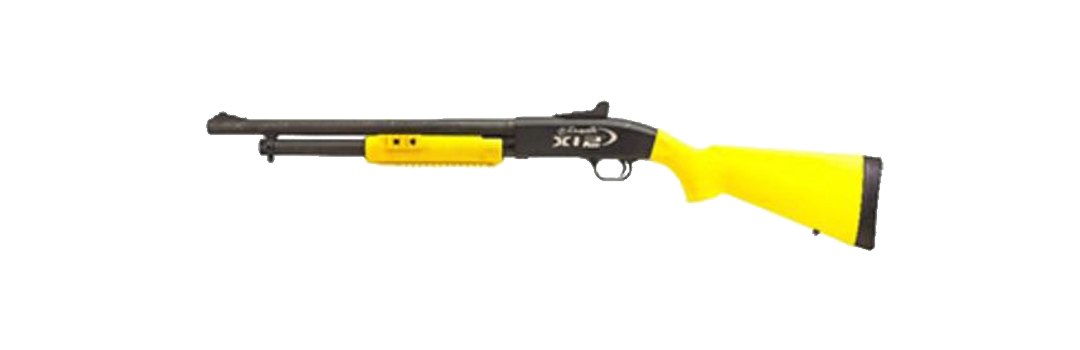
The TASER X12 represented one of the company's most ambitious experiments: a shotgun-style CEW that launched self-contained (no wire tethers needed) electronic projectiles capable of delivering an electrical charge at significantly greater distances. The X12 was intended to bridge the gap between traditional TASER devices and longer-range less-lethal tools. While the concept initially generated significant interest, the X12 never achieved the widespread adoption of the company's core handheld law enforcement products.
TASER X3 (2009)
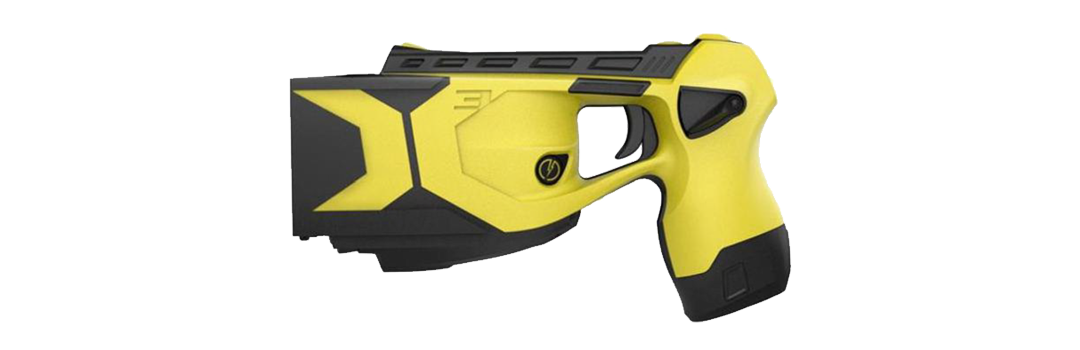
The TASER X3 introduced a major change in philosophy by becoming the company's first multi-cartridge CEW. Officers could deploy up to three cartridges before reloading, addressing a long-standing request for additional backup shots. The X3 also introduced several features that would become standard on later devices, including Smart Cartridges and enhanced electronics. Unfortunately, the weapon's large size ultimately limited its popularity. A problem that was quickly rectified a few years later.
TASER X2 (2011)

The TASER X2 refined many of the concepts introduced by the X3 while packaging them into a more practical form factor. The device featured two cartridges, giving officers an immediate follow-up shot without the bulk of the three-cartridge X3. It also included dual laser sights, improved performance monitoring, self-diagnostics, and compatibility with the new TASER CAM HD recording system (the precursor to modern day body cameras). The X2 emphasized reliability, accountability, and ease of use while preserving the benefits of multiple deployments. It became the foundation for many of the multi-shot TASER devices that followed.
TASER X26P (2013)
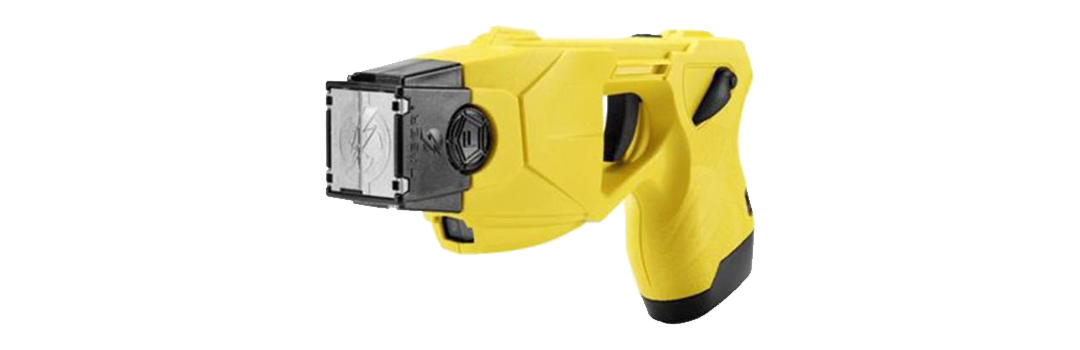
The TASER X26P modernized the proven X26 platform while retaining its familiar single-cartridge design. The device incorporated many of the technological improvements developed for the X2, including enhanced diagnostics, performance monitoring, and updated electronics. By combining newer technology with the compact form factor that officers already trusted, the X26P provided agencies with an evolutionary upgrade rather than a complete redesign.
TASER 7 (2018)
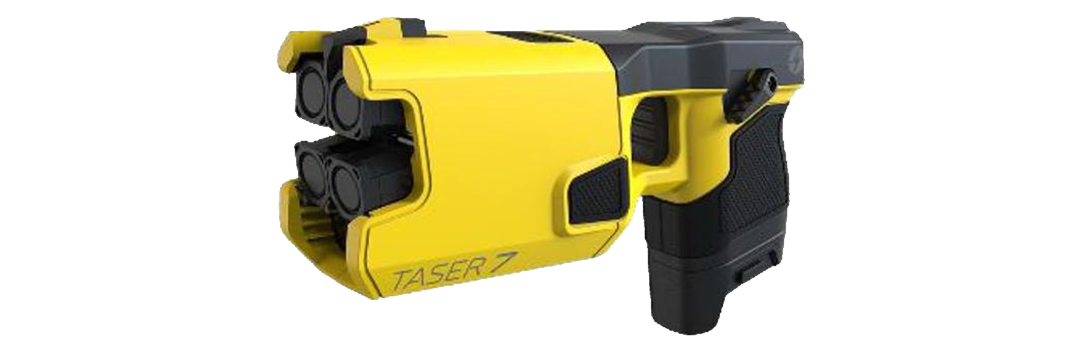
The TASER 7 introduced one of the most significant hardware redesigns since the X26. The device featured new projectiles that carried wire spools that unspooled wire tether directly behind them, allowing for straighter flight and improved connection performance at longer distances. It also introduced improved adaptive cross-connect capabilities, rechargeable batteries, and wireless device management. The TASER 7 was designed to be part of a complete ecosystem rather than simply a conducted electrical weapon, integrating more closely with Axon's training, reporting, and evidence-management platforms. It represented a major step toward the connected devices that define modern public safety technology today.
TASER 10 (2023)
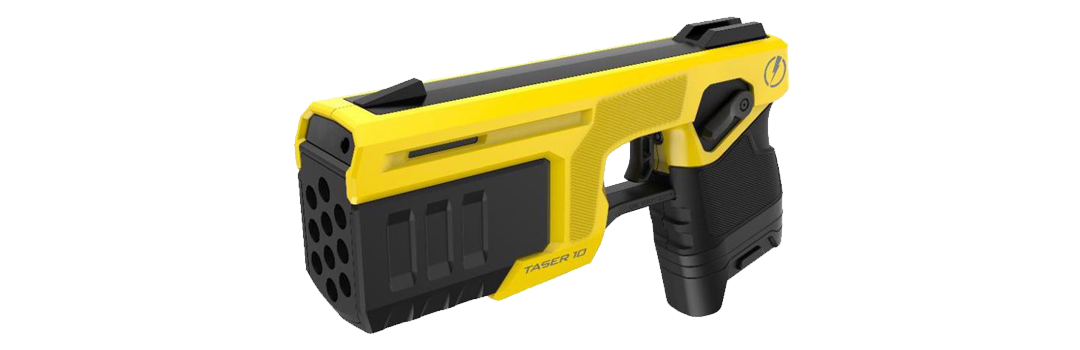
The TASER 10 is the most significant redesign in the history of the product line. Instead of one or two cartridges, the device carries ten individually deployable projectiles that can be fired separately. Unlike earlier TASER devices that relied on fixed spread angles (e.g., two projectiles were deployed simultaneously at different angles), the TASER 10 allows officers to “create” their own projectile spread by launching projectiles individually towards a target. In a drastic change from the nitrogen capsule deployment systems of the past 30 years, the TASER 10 is once again classified as a firearm as it utilizes gunpowder to launch each individual cartridge.
TASER Configuration Mark Registrations
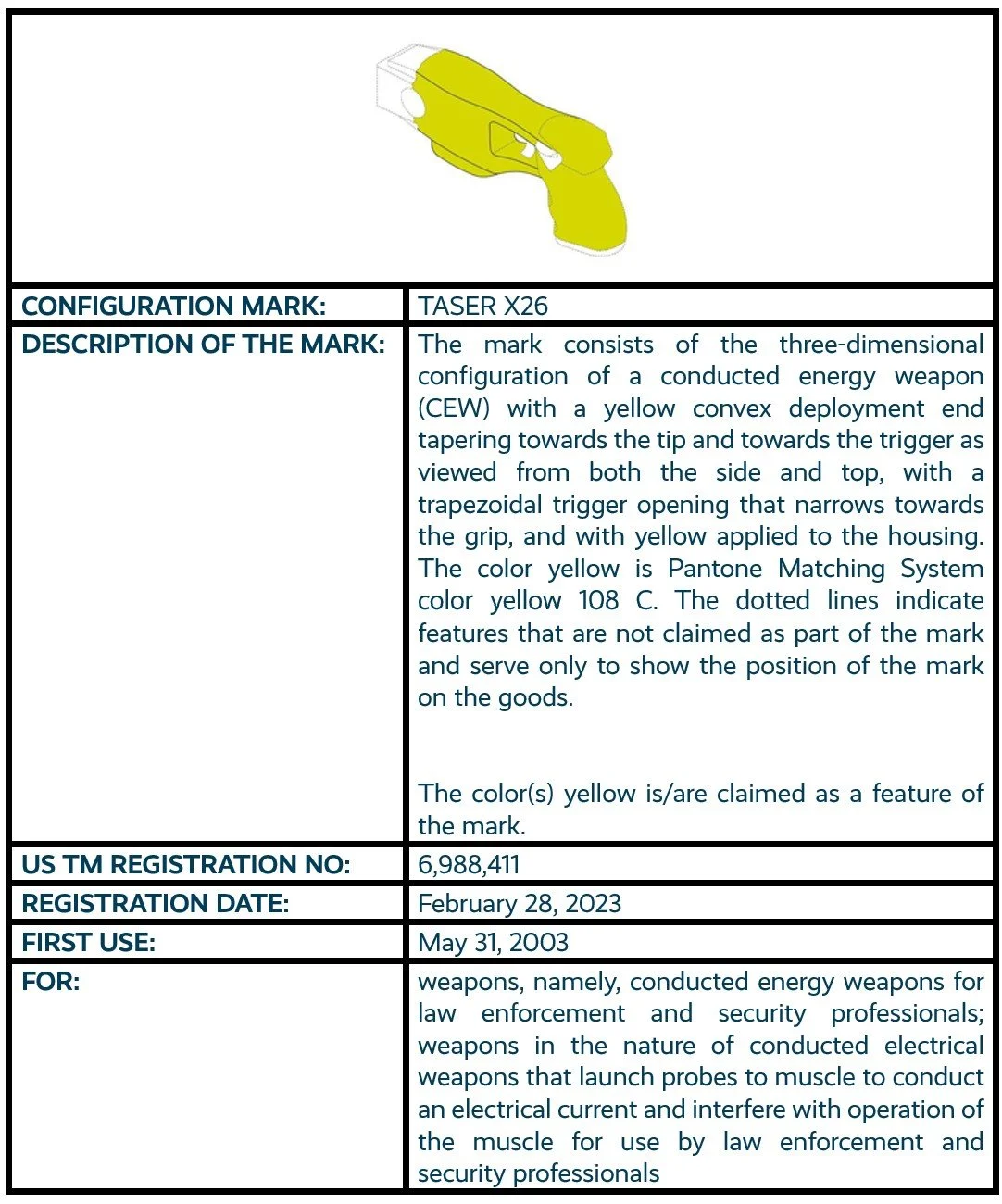
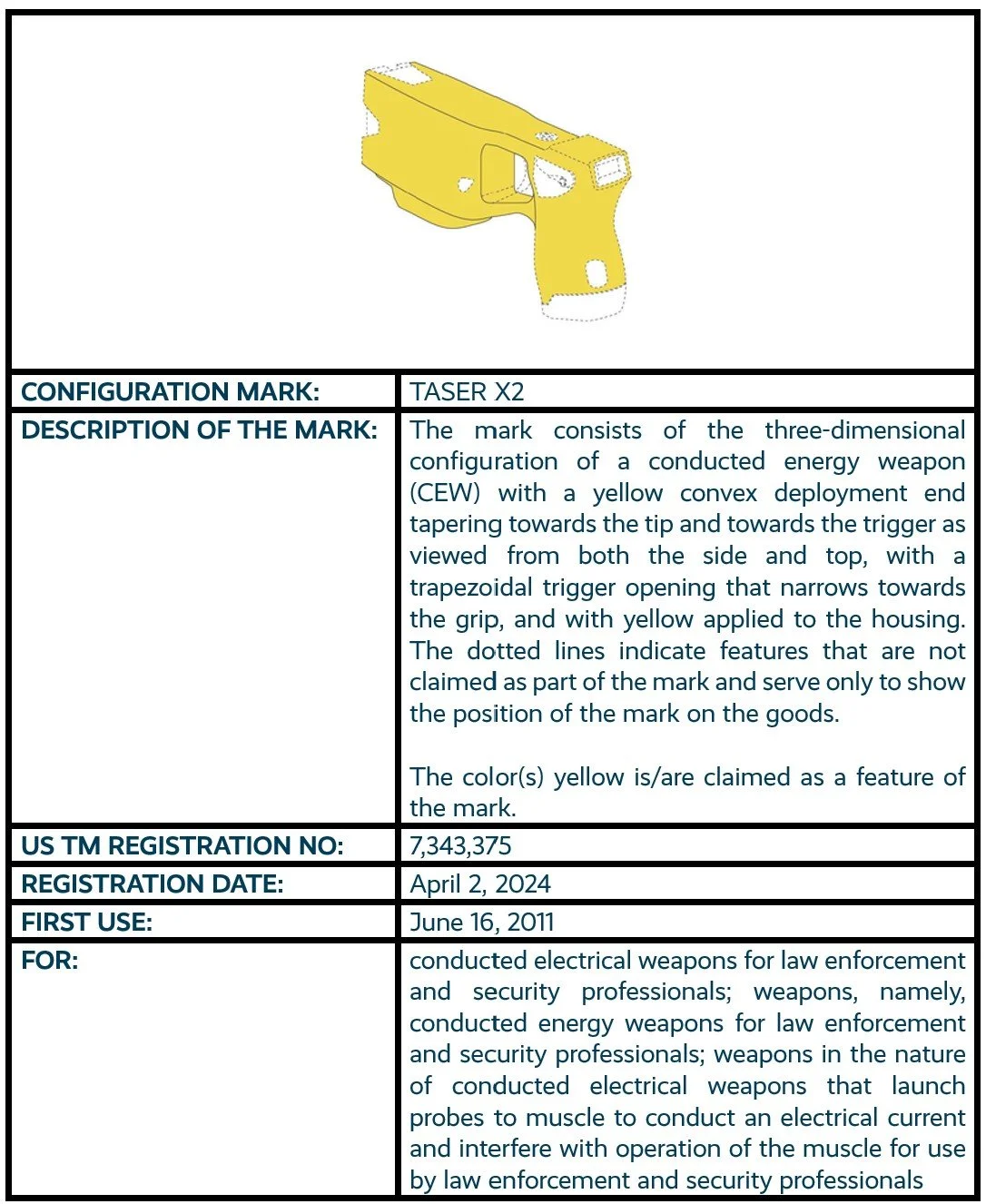
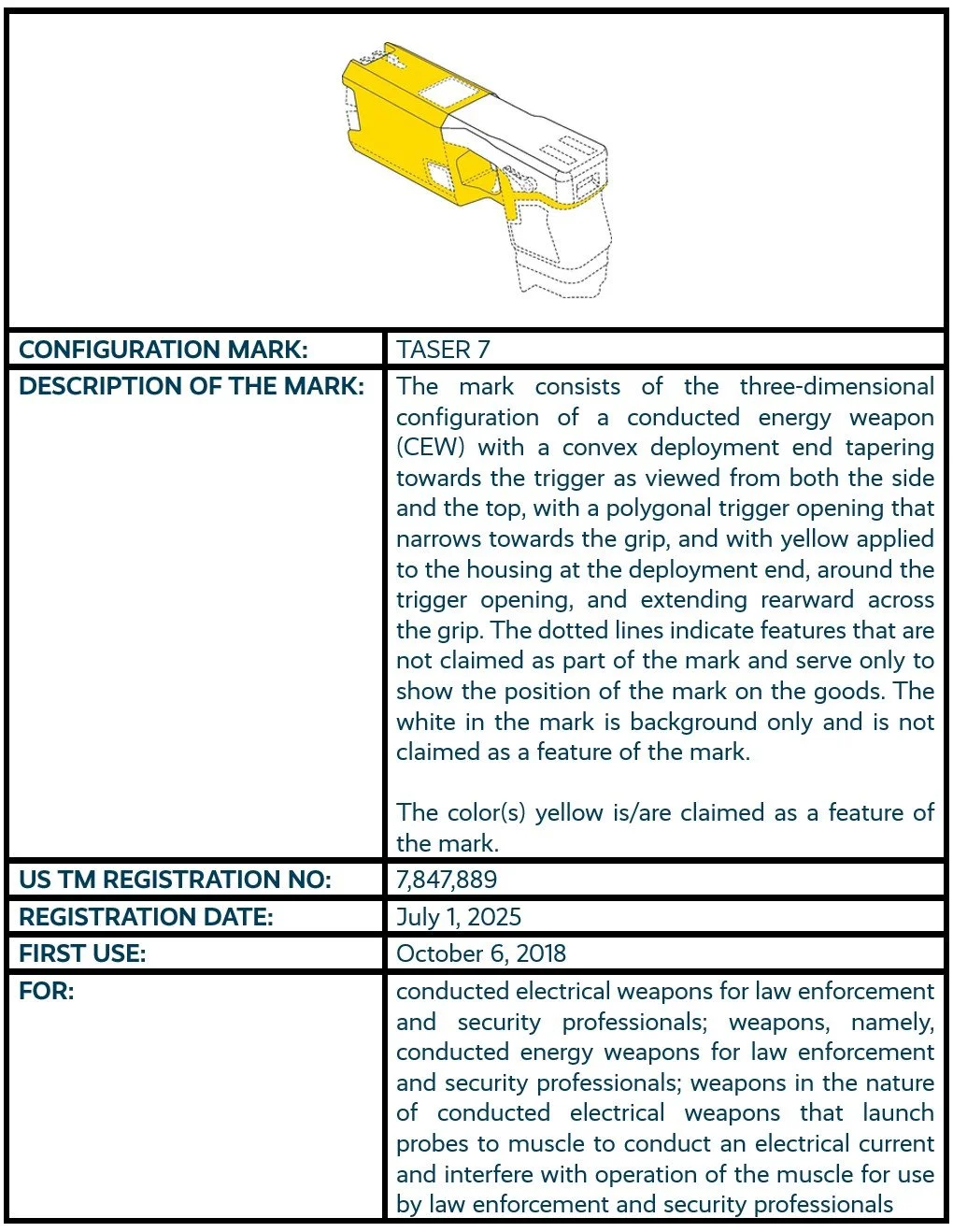
In addition to its Axon Yellow color mark registration, Axon owns a number of configuration mark registrations that protect the color yellow together with unique shapes of CEW models. The TASER X26 configuration mark [5] protects shared design features across the TASER X26, TASER X26C (civilian model), and TASER X26P CEWs, the TASER X2 configuration mark [6] protects design features of the TASER X2 CEW, and the TASER 7 configuration mark [7] protects design features of the TASER 7 CEW.
Interested in learning more about other yellow trademark registrations? Check out our posts on John Deere Green & Yellow, Wiffle Bat Yellow, Ski-Doo Yellow, and Ticonderoga Pencil.
[1] Axon Enterprise, https://www.axon.com/; Taser Self-Defense, https://taser.com/.
[2] USPTO, U.S. Trademark Registration No. 8,249,507, available at https://tsdr.uspto.gov/#caseNumber=99128470&caseSearchType=US_APPLICATION&caseType=DEFAULT&searchType=statusSearch.
[3] Axon Yellow, TASER BRAND, available at https://www.axon.com/taser-brand-information; How TASER-owner Axon is making a shade of yellow “the brand itself”, WORLD TRADEMARK REVIEW, posted February 2, 2026, and available at https://www.worldtrademarkreview.com/article/how-taser-owner-axon-making-shade-of-yellow-the-brand-itself; Evolution of the TASER Energy Weapon, AXON, available https://taser-evolution.axon.com/; Axon Trademark Notice, AXON, available at https://www.axon.com/trademarks; USPTO, Preliminary Amendment Filed May 12, 2025, U.S. Trademark Serial No. 99128470, available at https://tsdr.uspto.gov/documentviewer?caseId=sn99128470&docId=PRA20250513060921&linkId=9#docIndex=8&page=1.
[4] USPTO, U.S. Trademark Registration No. 7,707,117, available at https://tsdr.uspto.gov/#caseNumber=97651073&caseSearchType=US_APPLICATION&caseType=DEFAULT&searchType=statusSearch.
[5] USPTO, U.S. Trademark Registration No. 6,988,411, available at https://tsdr.uspto.gov/#caseNumber=90547375&caseSearchType=US_APPLICATION&caseType=DEFAULT&searchType=statusSearch.
[6] USPTO, U.S. Trademark Registration No. 7,343,375, available at https://tsdr.uspto.gov/#caseNumber=97726615&caseSearchType=US_APPLICATION&caseType=DEFAULT&searchType=statusSearch.
[7] USPTO, U.S. Trademark Registration No. 7,847,889, available at https://tsdr.uspto.gov/#caseNumber=98657756&caseSearchType=US_APPLICATION&caseType=DEFAULT&searchType=statusSearch.