
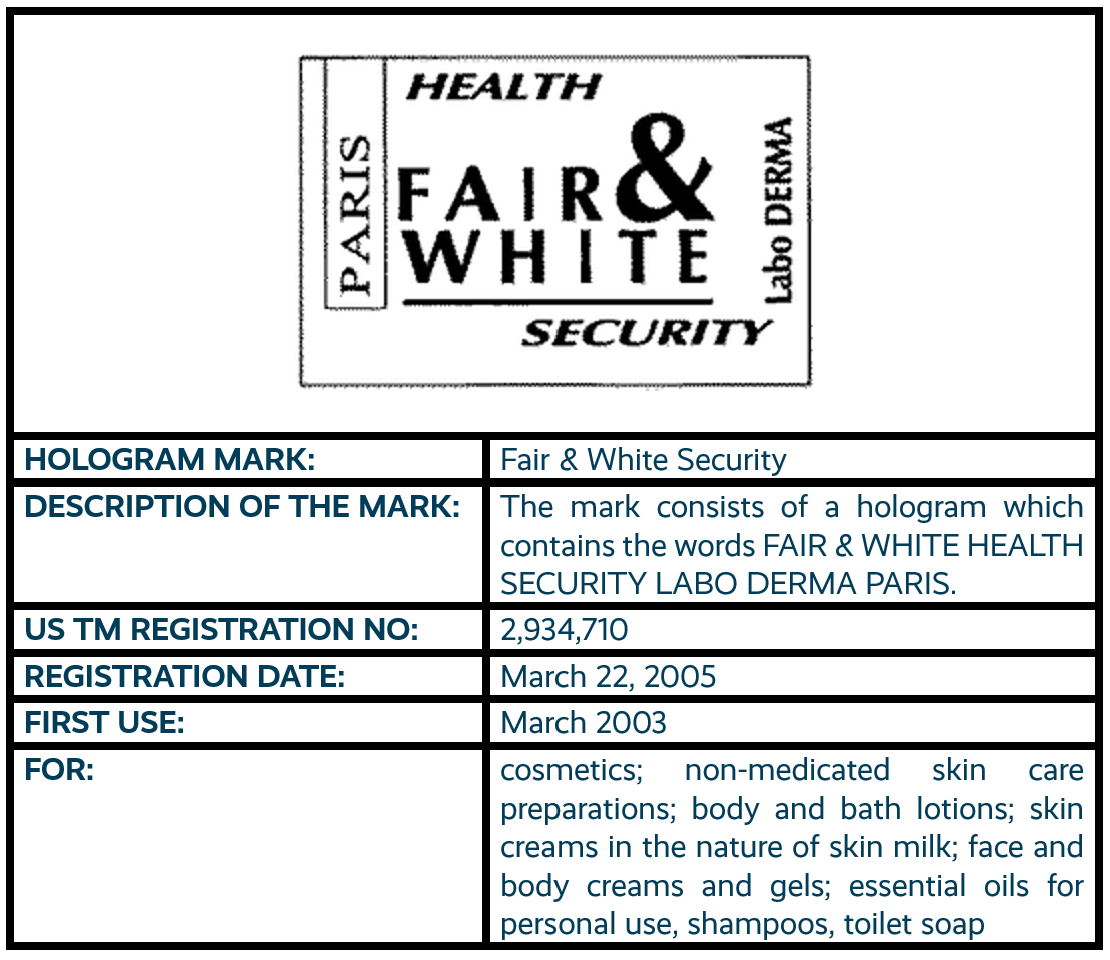
Fair & White Security Hologram

Trademark: Paris Fair & White Security Hologram
First Used: 2003
Registered: 2005
Current Owner: GAPARDIS HEALTH AND BEAUTY, INC. [1]
Trademark Type: non-traditional trademark; trade dress; hologram mark
Primarily Associated With: cosmetics; non-medicated skin care preparations; body and bath lotions; skin creams in the nature of skin milk; face and body creams and gels; essential oils for personal use, shampoos, toilet soap [2]
Brief (and likely incomplete) History [3]:
Fair & White was developed in France in the late 1990s by Continental Laboratories Medica, a French cosmetics company headed by pharmacist and chemist Xavier Tancogne. Tancogne developed the formula for the Fair & White product line, which was marketed primarily as skincare for darker skin tones and products addressing hyperpigmentation and uneven skin tone. Fair & White products quickly reached the United States, and in April 2000, Miami-based Gapardis Health & Beauty became the exclusive U.S. distributor for the French-made products.
Unfortunately, global expansion also brought a growing problem: counterfeit Fair & White products. By 2000, the company learned that products bearing the Fair & White brand name but manufactured by other companies were being sold in the United States. The problem became serious enough to produce litigation over competing versions of the products, with investigators later identifying counterfeit Fair & White products being sold in Florida stores.
Against that backdrop, Fair & White developed a holographic security label for its products. The resulting Fair & White Security hologram mark featured the Fair & White brand name surrounded by the words “HEALTH,” “SECURITY,” “PARIS,” and “Labo DERMA.” Although public records do not appear to expressly state why the hologram was created, its timing and presentation strongly suggest that it was introduced as an authentication device after years of counterfeit products, giving both distributors and consumers a visible way to distinguish genuine Fair & White products from the counterfeits that had already become a problem for the brand.
Copyright © 2026 by Illustrated IP, LLC. All rights reserved.
[1] About Us, FAIR AND WHITE, https://fairandwhite.com/pages/about-us.
[2] USPTO, U.S. Trademark Registration No. 2,934,710, available at https://tsdr.uspto.gov/#caseNumber=78246848&caseSearchType=US_APPLICATION&caseType=DEFAULT&searchType=statusSearch.
[3] About Us, FAIR & WHITE, available at https://fairandwhite.com/pages/about-us; International Cosmetics Exchange, Inc. v. Gapardis Health & Beauty, Inc., JUSTIA, decided August 26, 2002, available at https://law.justia.com/cases/federal/appellate-courts/F3/303/1242/505672/; International Cosmetics Exchange, Inc. v. Gapardis Health & Beauty, Inc., RESOURCE.ORG, decided August 26, 2002, available at https://law.resource.org/pub/us/case/reporter/F3/303/303.F3d.1242.01-16495.html; Gulam Nasser v. Gapardis Health & Beauty, Inc., Cancellation No. 92052226 (T.T.A.B. filed Mar. 19, 2010), and available at https://ttabvue.uspto.gov/ttabvue/v?eno=2&mode=frame&pno=92052226&pty=CAN.